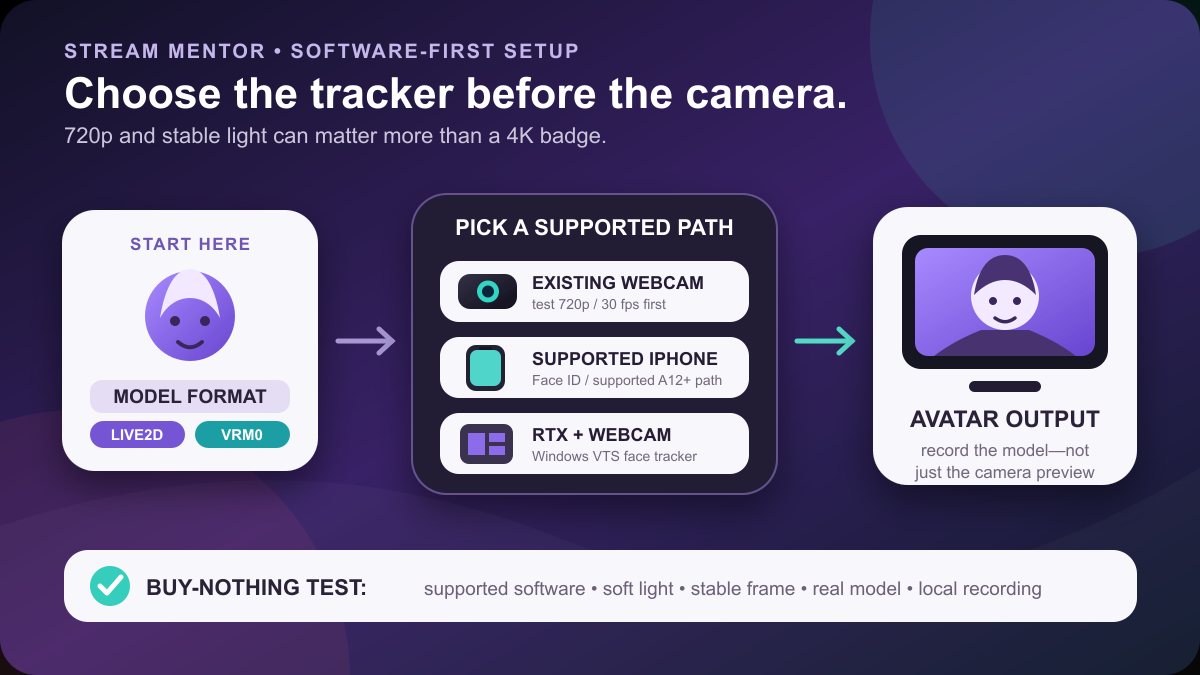
Quick answer: test the camera you already own before buying one for VTubing. VTube Studio recommends 1280 × 720 or higher and says 15–30 fps is sufficient for good webcam tracking. VSeeFace calls 720p–1080p its sweet spot and normally caps camera tracking at 30 fps. Your avatar software, model type, lighting, framing, and tracking method matter more than a 4K label.
Best starting paths:
- Live2D on VTube Studio: try an existing webcam first; use a supported Face ID or A12-or-newer Apple device when you already own one and want VTube Studio's higher-detail iOS tracking path.
- 3D VRM0 on VSeeFace: use a regular webcam on a supported Windows PC; VSeeFace does not support Live2D or VRM 1.0.
- Buying an inexpensive dedicated webcam: the Logitech C920s documents 1080p/30 fps, autofocus, and a 78° field of view—enough to meet VTube Studio's published resolution and frame-rate guidance.
- Buying a current flexible webcam: the Elgato Facecam Neo documents autofocus and 1080p at 30 or 60 fps, but the 60 fps mode is useful for other video work, not a proven VTuber-tracking upgrade.
- One camera for VTubing and visible 4K video: Logitech Brio documents 4K/30, 1080p/60, autofocus, and selectable fields of view; buy those features only if you will use them beyond avatar tracking.
- Windows PC with an NVIDIA RTX GPU: VTube Studio's free NVIDIA Broadcast Tracker DLC provides another officially supported webcam-tracking path without requiring a new camera, but it supports face tracking only and not hands.
Editorial update: Stream Mentor completely rebuilt this guide on July 24, 2026. The previous article presented a year-stamped product ranking with first-person performance claims that could not be supported, recommended discontinued FaceRig-era hardware, and treated 4K/60 fps as inherently better. This replacement compares documented requirements and use cases. Stream Mentor did not purchase or instrument-test these devices, and no manufacturer paid for inclusion.
Choose the tracking software before the camera
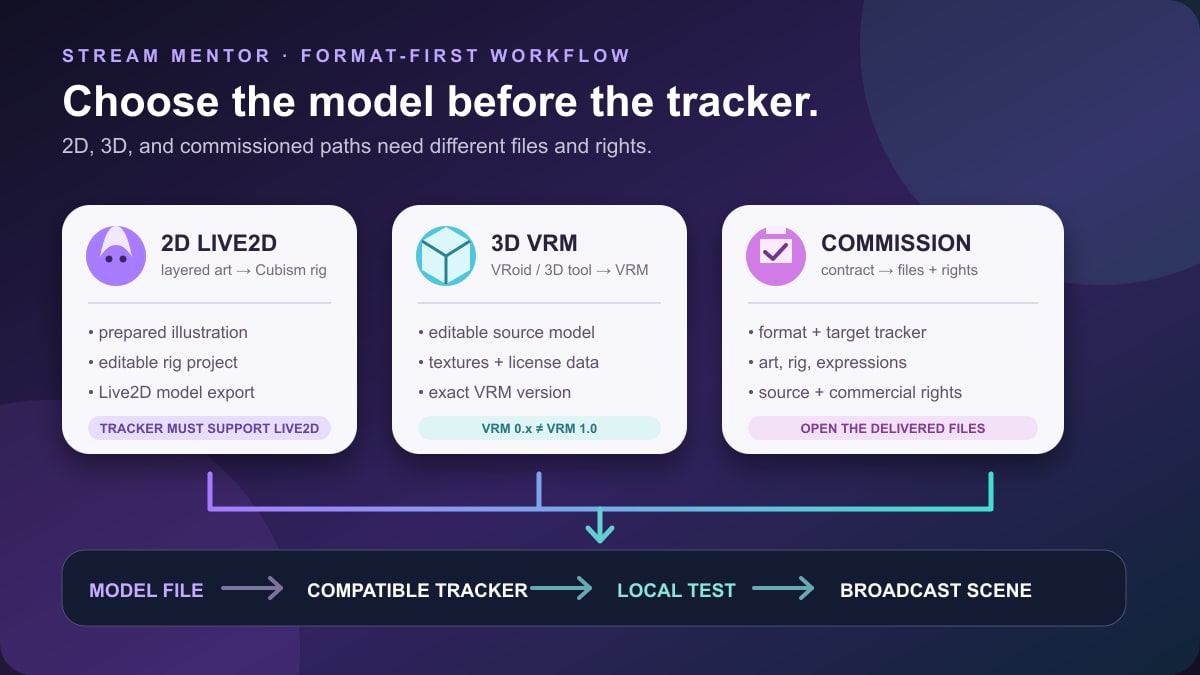
A “VTuber camera” does not animate the avatar by itself. Software interprets a webcam image or phone tracking data and maps the result to parameters your model was built to use. Buying before choosing the model format can leave you with capable hardware attached to incompatible software.
| Software path | Model support | Camera or phone input | Important limit |
|---|---|---|---|
| VTube Studio | Live2D Cubism only | Webcam, supported iPhone/iPad, or supported Android device | Does not support VRM or VRoid 3D models |
| VTube Studio NVIDIA tracker | Live2D through VTube Studio | Any webcam plus a supported NVIDIA RTX GPU | Windows only; face tracking only; no hand tracking |
| VSeeFace | VRM0 and VSFAvatar | Regular RGB webcam; compatible phone data can also be used through supported workflows | Windows 8 or newer, 64-bit; no Live2D and no VRM 1.0 |
Start with the site's VTuber software compatibility guide if you have not chosen an application. If you are still planning the whole project, the complete VTuber setup workflow keeps model, rigging, tracking, audio, broadcasting, and publishing decisions in the right order.
Best VTuber camera options by use case
| Path | Documented capability | Best fit | Do not assume |
|---|---|---|---|
| Your current webcam | VTube Studio says any webcam will do; 720p+ and 15–30 fps are its recommended baseline | First setup and no-cost compatibility test | That a new webcam fixes a poor rig, dark room, or wrong software |
| Supported iPhone or iPad | VTube Studio supports Face ID devices and certain A12-or-newer Apple devices; its manual ranks iOS above webcam and Android for tracking quality | Live2D users who already own a supported device or want that VTube Studio tracking path | That every old iPhone works, that it supports a VRM model directly, or that buying used is risk-free |
| Logitech C920s | 1080p/30, 720p/30, autofocus, fixed 78° diagonal field of view, privacy shutter | A straightforward dedicated 30 fps webcam | That Logitech certifies it as a superior VTuber tracker |
| Elgato Facecam Neo | 1080p/60 or 30, 720p/60 or 30, autofocus, 77° field of view, UVC 1.5 | A current autofocus webcam also used for calls or visible video | That 60 fps makes an avatar visibly twice as smooth |
| Logitech Brio | 4K/30, 1080p/60, 720p/90, autofocus, 65°/78°/90° field of view | One camera that must also create high-resolution visible video or support Windows Hello | That 4K produces better VTube Studio or VSeeFace tracking |
| Existing webcam + VTS NVIDIA tracker | Free VTube Studio DLC for Windows and NVIDIA RTX 20-, 30-, 40-, or 50-series GPUs, including supported laptop GPUs | A Windows/RTX owner who wants to test a different webcam tracker before changing hardware | GTX, AMD, Intel GPU, macOS, or hand-tracking support |
Best first choice: the webcam you already have
VTube Studio's official requirements say any webcam will do, recommend 1280 × 720 or higher for good eye and blink tracking, and call 15–30 fps sufficient. That makes an existing laptop camera or USB webcam the most responsible first test.
Do not judge it from the raw camera preview alone. Load the real model, calibrate it, and record the avatar output. A modest image can still produce usable tracking when the face is large enough in frame, evenly lit, and not hidden by hair, a microphone, hands, or reflective glare.
Best VTube Studio phone path: a supported Apple device you already own
VTube Studio supports iPhones and iPads with Face ID and also lists certain devices without Face ID when they have an Apple A12 or newer chip. Its own manual describes the tracking-quality order as iOS, then webcam, then Android. That statement comes from the VTube Studio developer's documentation; it is not an independent laboratory comparison of every device.
A compatible iPhone can send calculated face-tracking parameters to the desktop application. VTube Studio's current FAQ says the phone camera image and raw face-tracking data are not stored or transmitted to the PC; only calculated parameters are sent. You can set the phone's camera preview to “Never Show” if you do not want the face image displayed on the device.
Before buying a used phone only for tracking, verify:
- the exact model is on the application's supported path;
- Face ID and the front camera work, if the workflow depends on them;
- the battery is healthy enough for a long session and does not swell or overheat;
- the device can receive a supported operating-system and app version;
- Activation Lock is removed and ownership is legitimate;
- you have a stable stand, power cable, ventilation, and network or USB workflow;
- your Live2D rig exposes the parameters you expect to use.
The most capable tracker cannot create expressions the model was not rigged to display. Ask the rigger which parameters are included before paying for tracking hardware.
Best simple dedicated webcam: Logitech C920s
Logitech's current C920s product page documents 1080p at 30 fps or 720p at 30 fps, autofocus, a fixed 78° diagonal field of view, and a privacy shutter. Those modes meet VTube Studio's published baseline and sit inside VSeeFace's preferred resolution range.
The C920s is included here as a documented, widely supported 30 fps option—not because Stream Mentor measured it against newer webcams. It uses USB-A, so a USB-C-only computer needs a compatible adapter or dock. Confirm the exact regional model, operating-system support, return terms, and port before buying.
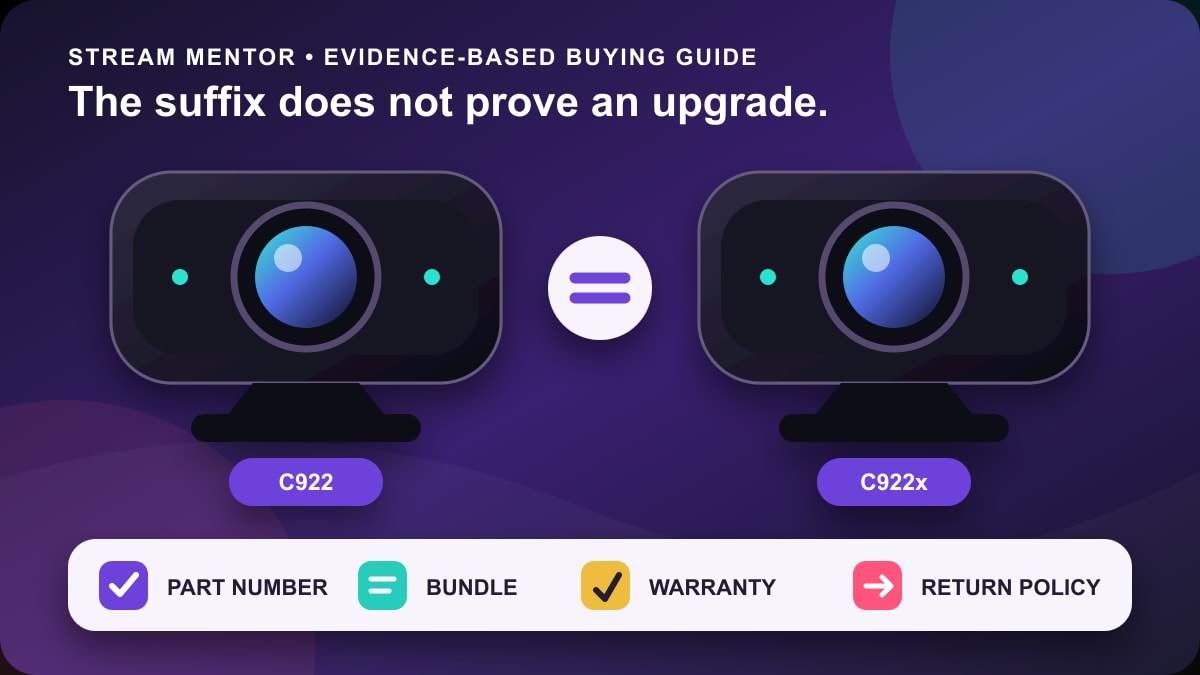
If you are comparing neighboring Logitech model names, the site's C922 versus C922x bundle guide shows why the exact part number and box contents matter more than a suffix.
Best current flexible 1080p option: Elgato Facecam Neo
Elgato's Facecam Neo specification lists 1080p at 60 or 30 fps, 720p at 60 or 30 fps, autofocus, a 77° field of view, UVC 1.5, and a fixed USB-C cable. It is a reasonable documented option when the same camera will be used for meetings, normal video, or a visible face shot as well as avatar tracking.
Do not buy it only because 60 is larger than 30. VTube Studio says 15–30 fps is sufficient, while VSeeFace says moving from 30 to 60 fps makes only a very small visible difference and doubles the tracking process's CPU usage. Use 30 fps first and compare a local recording before increasing the mode.
Elgato's live product and support documents have not always agreed on every operating-system and focus-range detail. Confirm current compatibility for your computer on the exact regional product and support pages before ordering.
Best dual-use 4K option: Logitech Brio
Logitech documents 4K at 30 fps, 1080p at 60 fps, 720p at up to 90 fps, autofocus, and 65°/78°/90° diagonal field-of-view choices for the Brio. Those features can be useful when the camera also needs to record a visible presenter, product, craft, or high-resolution crop.
They are not evidence of better avatar tracking. VTube Studio's NVIDIA tracker documentation says there is little to no tracking-quality difference between 1080p and 720p. VSeeFace explains that it crops and rescales the face for tracking, so going beyond 1080p offers little benefit to that process. Run the lowest stable mode that gives the tracker a clear face, then reserve 4K for a workflow that actually publishes the camera image.
Best no-camera-upgrade path for an RTX PC: VTube Studio's NVIDIA tracker
VTube Studio offers a separate NVIDIA Broadcast Tracker DLC. The official manual says it is free, Windows-only, approximately 2 GB, and requires an NVIDIA RTX-series GPU plus a webcam. It lists RTX 20-, 30-, 40-, and 50-series desktop and laptop GPUs; GTX and other GPU vendors are not supported.
The tracker handles face tracking only. It does not currently add hand tracking. This is a VTube Studio DLC using NVIDIA tracking technology, not a generic recommendation to install an unrelated camera-background application.
If you already own a compatible GPU, test the free DLC against VTube Studio's standard webcam trackers before replacing the camera. The manual recommends trying its MediaPipe tracker when an RTX GPU is unavailable.
Why lighting and framing beat extra pixels
Tracking software needs a consistent view of facial landmarks. VSeeFace's official guidance says insufficient light can quietly reduce a webcam's frame rate. It calls 720p–1080p the resolution sweet spot and warns that a ring light can help darkness but also create reflections on glasses or discomfort.
Improve the scene in this order:
- Place the camera near eye level. Avoid an extreme upward or downward angle that changes the visible eye and mouth shapes.
- Make the face large enough. Leave room for normal movement, but do not waste most of the frame on the room.
- Add soft front light. Light both sides of the face without a bright window or monitor dominating from behind.
- Check glasses. Move the light higher or to the side until reflections stop covering the eyes.
- Clear occlusions. Reposition a large microphone, hands, bangs, mask, or accessory if it repeatedly blocks tracked features.
- Lock unstable settings where supported. Autofocus or exposure hunting can change the image even while you sit still.
- Calibrate after placement. Calibrate in the actual seated posture and lighting used on stream.
A soft light or better placement may improve stability more than replacing one adequate 1080p webcam with another. The site's webcam setup guide covers framing, exposure, focus, and USB checks in more detail.
Camera resolution and frame rate for VTubing
720p is a legitimate tracking target
VTube Studio recommends at least 1280 × 720 for good eye and blink tracking. Its NVIDIA tracker guide says there is very little to no tracking-quality difference between 1080p and 720p. VSeeFace says 720p–1080p is its sweet spot because the face region is ultimately cropped and rescaled for tracking.
Start at 720p when the computer is already encoding a stream and rendering a game or model. Move to 1080p only when it is stable and the local avatar recording shows a useful difference.
30 fps is normally enough
VTube Studio calls 15–30 fps sufficient for good tracking. VSeeFace caps the camera at 30 fps by default and says 60 fps produces only a tiny visible improvement while doubling tracking-process CPU usage. VTube Studio's NVIDIA tracker can run faster, but its documentation notes that model motion is interpolated and going above 30 fps adds little visible quality.
A webcam's advertised 60 or 90 fps can still be useful for normal video or fast hand movement in a visible camera shot. That is a separate benefit from avatar face tracking.
4K is for dual use, not a baseline
Choose 4K when you also record the actual camera feed, crop it heavily, or need the camera for another production. Do not make the computer ingest and process 4K only because the mode exists. It can consume more USB bandwidth and processing resources without improving the avatar.
What a face camera cannot do
- It cannot change model format. VTube Studio remains Live2D-only; VSeeFace remains a 3D VRM0/VSFAvatar path.
- It cannot add unrigged expressions. Tracking data needs corresponding model parameters and rigging.
- It is not automatically full-body tracking. Face tracking, hands, upper body, and room-scale motion can require different software or hardware.
- It cannot guarantee privacy by itself. Configure scenes so the raw camera is never accidentally added to OBS, close previews you do not need, and test every scene before going live.
- It cannot fix overloaded production hardware. Rendering, tracking, gaming, encoding, browser sources, and effects share system resources.
VSeeFace's optional hand-tracking path uses separate Leap Motion hardware; VTube Studio's NVIDIA face tracker explicitly does not support hands. Check the current documentation for the software and tracking feature you actually need.
Ten-minute test before the return window closes
- Install from the official source. Use the camera maker and avatar application's official product or store pages.
- Connect directly. Test a computer port before adding a hub, extension, or adapter chain.
- Select 720p/30 first. Confirm the software reports the expected camera and mode.
- Use the real scene. Open the final model, game, OBS collection, lights, and microphone.
- Calibrate. Sit where you will stream and complete the application's normal calibration.
- Move naturally. Blink, look toward the screen corners, turn your head, speak, smile, and make the expressions the model supports.
- Check obstruction. Move near the normal edges of the frame and speak into the microphone without covering the mouth.
- Record locally for ten minutes. Review the avatar output, not only the tracking dots or raw webcam.
- Watch system load. Look for tracking lag, dropped camera frames, encoder overload, game stutter, heat, or USB disconnects.
- Compare one change at a time. Try better light, 1080p, another tracker, or 60 fps separately so you know what helped.
Return or exchange a camera that cannot hold its documented mode on the intended computer, repeatedly disconnects, arrives with a different model or condition, or cannot frame the normal movement area. Do not keep it merely because a generic “best VTuber camera” list ranked it.
Frequently asked questions
Do I need a webcam to become a VTuber?
You need a tracking input only when the chosen performance workflow requires one. VTube Studio can use a webcam or compatible phone. Some avatar content can instead use hotkeys, prerecorded animation, audio-driven movement, or another tracking device. Choose the model and software workflow first.
Is an iPhone better than a webcam for VTube Studio?
VTube Studio's own requirements page ranks its tracking quality as iOS above webcam above Android. A supported iPhone can expose a richer phone-tracking path, but results still depend on device support, model rigging, calibration, placement, light, and the parameters you use. Try an existing webcam before buying a phone solely for tracking.
Which iPhone works with VTube Studio?
The current VTube Studio requirements list iPhones and iPads with Face ID, plus certain devices without Face ID when they have an Apple A12 or newer chip. Consult the live requirements before buying because app and operating-system support can change. Verify the exact used device, front camera, Face ID where applicable, battery, ownership lock, and return policy.
Is 4K or 60 fps better for VTubing?
Not necessarily. VTube Studio says 720p or higher and 15–30 fps are sufficient. VSeeFace calls 720p–1080p its sweet spot and says increasing tracking from 30 to 60 fps gives a very small visible difference while doubling tracking CPU usage. Higher modes make more sense when the real camera image is also part of the content.
Does VTube Studio support 3D VRM models?
No. VTube Studio's official requirements say it supports Live2D models and not VRM or VRoid. VSeeFace is one Windows option for VRM0 and VSFAvatar models, but its documentation says it does not support VRM 1.0 or Live2D.
Can VTube Studio show my real face by accident?
VTube Studio says its phone workflow sends calculated parameters rather than the camera image or raw tracking data to the desktop, and the PC/Mac application has no function to reveal that phone image. Separate broadcast software can still expose any raw webcam source you manually add. Audit every OBS scene, studio mode, virtual camera, and screen share before going live.
Should I use a DSLR or mirrorless camera for face tracking?
Usually not as the first purchase. VTube Studio says some users report DSLR problems, while ordinary webcams meet its documented baseline with less capture complexity. A larger camera can make sense when you also publish a high-quality visible camera feed, but then you must verify clean output, capture hardware, heat, power, autofocus, latency, and software compatibility.
Sources and review scope
- VTube Studio: Introduction and requirements for model format, supported phone paths, webcam resolution, frame rate, and the developer's tracking-quality order.
- VTube Studio: current FAQ for phone-camera privacy, commercial-use notes, trial behavior, and webcam support.
- VTube Studio: NVIDIA Webcam Tracker documentation for platform, GPU, download, frame-rate, resolution, interpolation, and hand-tracking limits.
- VSeeFace: official requirements and webcam guidance for model and platform support, 720p–1080p guidance, default 30 fps cap, CPU tradeoff, lighting, and tracking limits.
- Logitech: C920s product page for current documented video modes, autofocus, field of view, and privacy shutter.
- Elgato: Facecam Neo product page for video modes, autofocus, field of view, cable, and UVC specification.
- Logitech: Brio product page for video modes, autofocus, selectable field of view, connection, and privacy shutter.
Requirements, manufacturer pages, and visible competing recommendations were reviewed on July 24, 2026. Stream Mentor compared current first-party documentation and did not buy, benchmark, or low-light-test these cameras. Availability, prices, regional part numbers, operating-system support, app support, and firmware can change. Re-check the exact device and software documentation before purchasing.