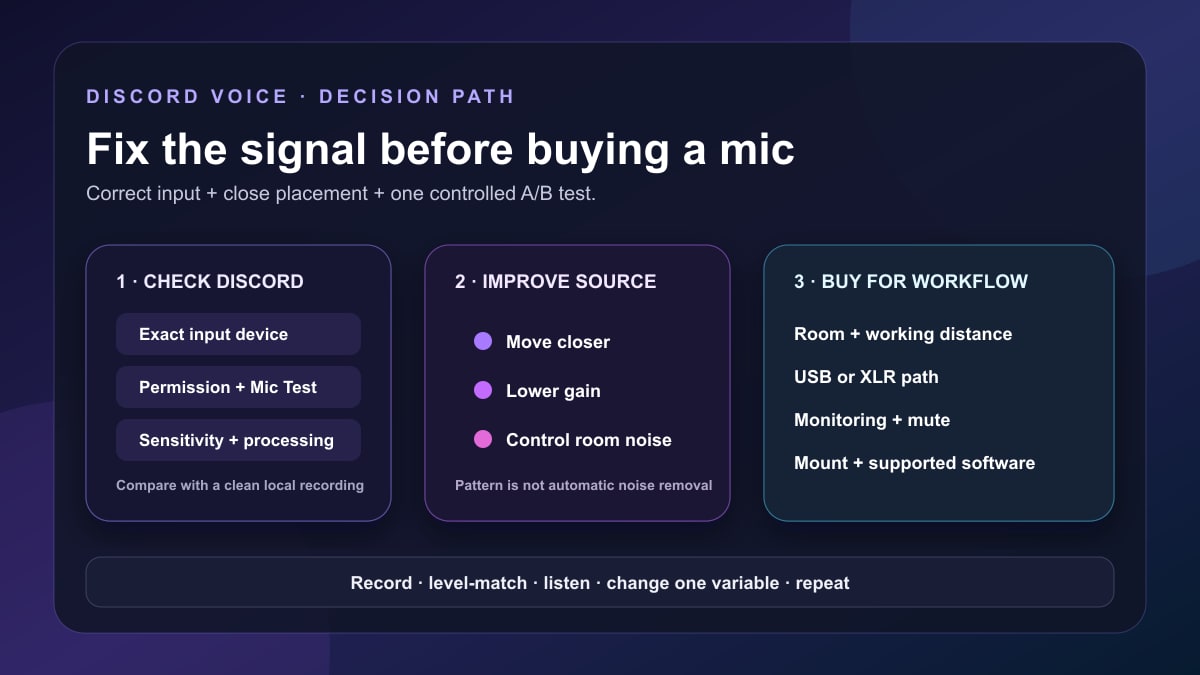
Quick answer: before buying a microphone for Discord, select the correct input, run Discord's Mic Test, check operating-system permissions, and place the current mic close enough for clear speech. If hardware is still the limit, choose by room noise, working distance, connection, monitoring, mute control, and budget—not by a universal “best” ranking.
Three current source-based starting points are the Elgato Wave Neo for a simple USB desk setup in a reasonably controlled room, the Audio-Technica ATR2100x-USB for close dynamic speech with USB and an XLR upgrade path, and the Shure MV6 for a close-address dynamic USB setup with its documented DSP features. These are workflow examples from official specifications, not products Stream Mentor claims to have tested.
Editorial update: Stream Mentor completely rebuilt this guide on July 24, 2026. The old page ranked seven microphones, repeatedly claimed extensive testing without a method, mislabeled pickup patterns and monitoring connections, and used unsupported “professional,” noise-suppression, durability, and audio-quality claims. Those rankings and two unlicensed graphics have been removed.
Fix the Discord input before buying a microphone
Discord's current Voice and Video Troubleshooting Guide starts with the basics that solve many “bad mic” reports:
- Confirm the microphone is connected and recognized by the operating system.
- Open User Settings → Voice & Video.
- Select the exact input rather than relying on a changing default.
- Use Mic Test and watch the input meter while speaking at the real distance.
- Check input volume, input mode, and sensitivity.
- Confirm microphone permissions for Discord or the browser.
- Temporarily disable conflicting exclusive access, virtual devices, or processing to isolate the problem.
- Use Discord's reset or troubleshooting steps only after recording the current settings.
Also test a local recording outside Discord. If the local file sounds clean but Discord does not, hardware replacement may not solve the routing, sensitivity, network, or processing issue.
Headset mic or standalone mic?
| Setup | Strength | Trade-off to test |
|---|---|---|
| Headset or boom mic | Keeps distance consistent as the user moves | Comfort, breath noise, wireless behavior, repairability, and voice quality |
| USB desk mic | Simple digital connection with no separate interface | Desk vibration, keyboard pickup, port availability, software, and placement |
| USB/XLR dynamic mic | Can start on USB and move to an interface later | Needs close placement and enough clean gain in the selected path |
| XLR mic and interface | Flexible routing, controls, and component replacement | Higher complexity, more cables, correct gain, monitoring, and total cost |
For ordinary Discord conversation, consistent placement can matter more than an expensive capsule. A headset microphone two inches from the mouth may deliver clearer speech than a premium desk mic two feet away in a noisy, reflective room.
Choose for the room and working distance
Use close placement in a noisy room
Move the microphone closer and reduce gain so the voice is stronger relative to keyboard, fans, television, other people, and room reflections. A dynamic cardioid microphone is often considered for close speech because that workflow can emphasize the nearby voice, but the pickup pattern does not erase sound. Keyboard position, rear and side rejection at different frequencies, desk transfer, and the speaker's technique still matter.
A condenser can work in a controlled setup
USB condenser microphones can provide a convenient detailed signal, but a distant high-gain position also captures more room. Use a boom arm or stand that places the mic near the mouth without blocking the screen. Test keyboard and mouse clicks while speaking, not during silence only.
Pickup pattern is not a noise-cancellation rating
Cardioid describes directional sensitivity, not a promise to remove everything behind the mic. The quietest direction varies by frequency and microphone. Speak into the side or end identified by the manufacturer's manual; pointing the wrong part at the mouth can produce a weak, noisy result.
Three current USB workflow examples
Specifications and availability were checked July 24, 2026. Prices vary by country and retailer, so this article does not publish a price that will silently age.
Elgato Wave Neo: simple USB desk workflow
Elgato's current Wave Neo page describes a USB microphone intended for voice, with a cardioid pattern, included desk stand, tap-to-mute, headphone connection, and Wave Link software compatibility. That combination can suit someone who wants an integrated desktop path and is willing to position a condenser close in a reasonably controlled room.
Check operating-system support, the ports and adapters in your exact computer, whether Wave Link fits the routing plan, and whether the stand reaches an appropriate mouth distance. Official specifications cannot tell you how much keyboard and room sound it will capture in your setup.
Audio-Technica ATR2100x-USB: USB now, XLR later
The ATR2100x-USB manual documents a cardioid dynamic microphone with USB-C and XLR outputs plus a headphone output for monitoring in USB operation. This makes it a practical source-based example for close speech and a future move to an audio interface.
USB and XLR are alternative signal paths, not a guarantee that both should feed the same computer simultaneously. The XLR output needs an appropriate microphone input; the USB path uses the microphone's own conversion. Confirm which controls and monitoring functions apply to each path.
Shure MV6: close dynamic USB speech with DSP options
Shure's current MV6 page describes a dynamic USB gaming microphone with voice-isolation positioning, Auto Level Mode, a digital pop filter, real-time denoising, tap-to-mute, and headphone monitoring, with settings available through Shure's software.
Those are manufacturer-documented features, not proof that every processing option should be enabled. Compare raw and processed recordings at matched listening levels. Strong denoising can create artifacts when the room, keyboard, or speech pattern differs from the intended use.
| Example | Connection | Documented workflow distinction | Verify before buying |
|---|---|---|---|
| Elgato Wave Neo | USB | Cardioid condenser desk workflow and Wave Link integration | Room pickup, stand height, OS/software support, adapters |
| ATR2100x-USB | USB and XLR | Close dynamic speech with a future interface path | Mount, USB monitoring behavior, interface gain for XLR |
| Shure MV6 | USB | Close dynamic speech with documented DSP controls | Software support, processing artifacts, mount and mouth distance |
These examples do not cover every budget, region, or need. A working headset mic may remain the better purchase decision if it keeps distance consistent and passes the test.
Placement and gain setup
- Identify whether the mic is side-address or end-address from its manual.
- Start roughly a hand's width from the mouth, slightly off-axis to reduce plosives, unless the manufacturer directs otherwise.
- Keep the microphone closer to the speaker than to the keyboard.
- Set gain while speaking at the loudest realistic Discord level. Avoid clipping.
- Use a pop filter or windscreen if plosives remain; it does not replace correct position.
- Prevent the stand or cable from transferring desk impacts. A boom arm or isolation mount may help, but test it.
- Listen through headphones at a moderate level and make a local recording.
- Then run Discord's Mic Test with the same input and position.
Do not solve a distant microphone by maximizing gain and then expect software to reconstruct a clean close voice. Improve the source-to-noise ratio first.
Discord sensitivity and voice processing
Automatic or manual input sensitivity
Automatic sensitivity is convenient when the level and environment change. Manual sensitivity can help when Discord repeatedly cuts off quiet words or opens for constant noise. Set it while speaking naturally and producing the background noises that occur during a call.
Noise suppression with Krisp
Discord's Krisp FAQ explains its built-in noise-suppression option and current limitations. Suppression can reduce some non-speech noise, but it is processing, not soundproofing. Compare it on and off. If it removes consonants, pumps, or produces watery artifacts, improve placement and reduce the noise before relying on stronger processing.
Echo cancellation and headphones
Headphones prevent speaker output from returning to the mic and are the cleanest fix for many echo cases. Echo cancellation can help a speakerphone-style setup but may affect speech when people talk over one another. Test the real call behavior.
Do not stack processors blindly
A microphone app, audio interface, operating-system enhancement, broadcast suite, and Discord can each add noise removal, compression, gating, or automatic level. Stacking several processors can cause pumping, clipping, and dropouts. Start with a clean direct signal, add one change, record, and compare.
A five-minute A/B microphone test
Make the comparison reproducible rather than choosing from a dramatic processed demo.
- Place each option at its intended mouth distance and direction.
- Record the same 30-second script, including quiet and loud speech.
- Type and click the mouse while speaking, then pause for five seconds.
- Match playback loudness before judging; louder often sounds superficially better.
- Listen for clarity, plosives, clipping, room echo, keyboard intrusion, and missing word beginnings.
- Repeat through Discord Mic Test and one private call because the app's processing path matters.
- Ask the listener to score intelligibility and fatigue without telling them which mic costs more.
Keep the raw files, placement photo, gain, Discord settings, and processing state. That is a real test record; “tested” in a product title without those controls is not.
Connection and monitoring checklist
- Does the computer have the required USB port, power, and supported operating system?
- Will a hub, dock, or adapter pass audio reliably?
- Can the microphone's headphone output monitor the mic directly, computer playback, or both?
- Is there a physical mute with a visible state?
- Will Discord and the game use the same sample-rate path without resampling problems?
- Can the stand or arm hold the microphone without sagging?
- For XLR, does the interface provide an appropriate mic preamp, input, monitoring, and required phantom power?
- Can you restore a known-good setup after an operating-system or app update?
When not to buy a new microphone
Keep the current mic if close placement, correct input selection, permission repair, lower gain, headphones, and one carefully chosen processing stage produce clear speech. Spend first on the actual bottleneck: a stable stand, quieter fan profile, keyboard position, headphones, or room treatment.
Replace hardware when it has an unfixable connection fault, self-noise, intermittent cable or port, inadequate working distance, missing monitoring or mute control required by the workflow, or no supported path to the current computer.
Frequently asked questions
What microphone is best for Discord?
The one that produces intelligible speech in your room at a comfortable distance, connects reliably, and passes Discord Mic Test without destructive processing. A headset, close dynamic USB mic, or properly positioned condenser can each win in a different setup.
Does Discord make a microphone sound better?
Discord can apply sensitivity, gain, echo cancellation, and noise suppression, but processing cannot recover detail that was never captured or remove every overlapping sound cleanly. Start with placement and a healthy input signal.
Is a dynamic mic always better for keyboard noise?
No. Close placement and lower gain often help, but pickup pattern, keyboard position, room, mic design, and technique matter. A distant dynamic mic can still require enough gain to capture substantial room noise.
Do I need XLR for Discord?
No. USB is simpler and can be entirely adequate. XLR is useful when you want a particular microphone, interface controls, routing, multiple inputs, or a component upgrade path.
Why can nobody hear me even though the mic works?
Check Discord's selected input, input mode, sensitivity, volume, mute state, operating-system permission, channel permissions, and browser permission where relevant. Test locally and follow Discord's current troubleshooting guide before replacing hardware.
Sources and review scope
- Discord Voice and Video Troubleshooting for current input and app checks.
- Discord's Krisp FAQ for noise-suppression behavior and limitations.
- Shure MV6, Elgato Wave Neo, and the Audio-Technica ATR2100x-USB manual for manufacturer specifications.
Primary sources and current visible competing results were reviewed on July 24, 2026. Stream Mentor did not perform a hands-on comparison of these microphones, so this source-based guide does not claim subjective sound, comfort, durability, or universal performance.