Quick answer: start with the official OBS Studio plugin, then add only the controls that remove a repeated interruption from your stream. For most creators, that means Discord, Twitch or YouTube, an audio-control plugin, and one tool for lights or voice effects. Installing dozens of plugins usually creates a harder-to-navigate deck rather than a better one.
This guide was substantially rewritten in July 2026. We checked every recommendation against the current Elgato Marketplace or the plugin maker's documentation, removed discontinued Twitch Studio advice, and separated official integrations from community plugins.
Best Stream Deck plugins for streamers
| Plugin | Best for | Platforms | Cost |
|---|---|---|---|
| OBS Studio | Scenes, sources, recording, and audio | Windows, macOS | Free |
| Discord by Elgato | Voice-chat controls | Windows, macOS | Free |
| Twitch | Chat and channel actions | Check the selected action | Free options |
| YouTube by Elgato | Live-stream and channel controls | Windows, macOS | Free |
| Spotify by Elgato | Playback and volume | Windows, macOS | Free |
| Audio Mute | Emergency microphone or speaker mute | Check Marketplace listing | Free |
| Control Center | Elgato lighting | Windows, macOS | Free |
| Voicemod | Voice effects and soundboard actions | Check Marketplace listing | Free/paid app features |
Compatibility and version requirements can change. Treat the Marketplace listing—not an old roundup—as the final check before installing.
1. OBS Studio: the best first plugin for most streams
The official OBS Studio integration covers the controls that most often pull a creator out of the moment: changing scenes, showing or hiding sources, muting individual audio sources, starting a recording, saving the replay buffer, and entering Studio Mode.
Its most useful feature is feedback. A key can reflect whether a source is visible, a microphone is muted, or recording is active. That is safer than a generic keyboard shortcut because you can see the current state before pressing anything.
Use it for: a starting-soon scene, camera changes, a privacy scene, microphone mute, recording, and replay-buffer clips. Elgato currently lists Stream Deck 6.9 or later, Windows 11 or later, or macOS 13 or later for its current OBS plugin. Check the official page if you use an older system.
2. Discord: control voice chat without opening the app
Discord by Elgato is useful when a live show includes guests, co-streamers, or a community voice channel. Put the actions you may need under pressure—mute, deafen, push-to-talk, or moving between configured controls—on a dedicated page.
Keep an emergency mute on the first page of your deck. A control that takes two folder taps to find is not an emergency control.
3. Twitch: use channel actions, not the discontinued Twitch Studio app
The old version of this article recommended a Twitch Studio plugin. Twitch ended Twitch Studio support after May 30, 2024, so that recommendation is no longer appropriate.
For a Twitch stream in 2026, run the production through supported software such as OBS and use current Twitch Marketplace actions for channel or chat tasks. Useful actions depend on the plugin, but may include chat messages, markers, clip creation, channel information, or engagement controls. Verify the maker, operating system, required Stream Deck version, update history, and requested account permissions before connecting a Twitch account.
4. YouTube: useful for creators who stream and publish
The official YouTube plugin is a sensible choice if your workflow moves between live streams and regular uploads. Keep live controls separate from analytics displays: operational keys should start, stop, or change something, while a stats page can show channel information without cluttering the production page.
Do not place a destructive or public action beside a frequently used scene key. Use folders, distinct icons, and—where the action supports it—a confirmation or long press.
5. Spotify: convenient, with an important streaming caveat
Spotify by Elgato can control play, pause, shuffle, and volume from keys or supported dials. It is useful for personal listening and pre-production.
Do not assume a Spotify subscription gives you permission to rebroadcast music. Streaming platforms and rights holders apply separate rules. For a live production, use music that is licensed for that use and keep the music source on its own audio channel so it can be removed from a VOD when required.
6. Audio Mute: the small plugin that can save a stream
A dedicated mute control is more valuable than many elaborate effects. Configure one key for the microphone and, if needed, another for desktop audio. Use clearly different icons and make the active state obvious.
Test the key while monitoring the actual stream mix—not only the Windows or macOS device meter. Muting an input device is not always the same as muting the source that OBS is sending.
7. Control Center: best for Elgato lights
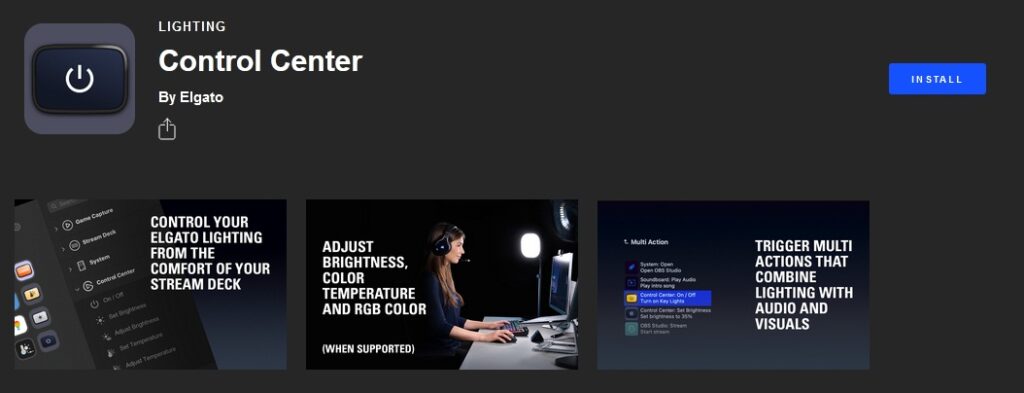
Control Center puts supported Elgato light power, brightness, and color-temperature controls on the deck. This is most helpful when you reuse the same room for calls, recording, and streaming.
Create one Multi Action for your normal live setup and a separate shutdown action. Avoid assuming every third-party light will work; confirm compatibility in Control Center before designing a profile around it.
8. Voicemod: best when voice effects are part of the show
Voicemod can expose voice effects and soundboard actions on Stream Deck. It is worth adding when those effects are a deliberate part of your format. If they are only occasional, put them on a secondary page so they do not displace scene, audio, or safety controls.
Test levels before going live. Soundboard clips can be dramatically louder than speech, and copyrighted clips can create the same rights problems as rebroadcast music.
How to install a Stream Deck plugin
- Update the Stream Deck app. Elgato's current plugin guide requires Stream Deck 6.4 or newer for Marketplace installation, while individual plugins may require a newer version.
- Open the Marketplace icon in the Stream Deck app, or visit the Elgato Marketplace.
- Sign in with a Marketplace account.
- Open the plugin listing and check the maker, supported operating systems, Stream Deck version, price, permissions, update date, and support link.
- Select Get or purchase the plugin, then allow it to open in Stream Deck.
- Find the plugin in the action list and drag only the actions you need onto a key, dial, or folder.
- Run a private recording or test stream and verify every key, including its on/off state.
If an old plugin no longer appears, do not download an installer from an unknown mirror. Search the Marketplace for a maintained replacement or use a native Stream Deck hotkey action.
A practical five-key starter layout
- Scene: switch between the main camera and gameplay.
- Microphone: mute with a visible red muted state.
- Privacy: hide sensitive sources or switch to a safe scene.
- Record/clip: start recording or save the replay buffer.
- Folder: open secondary controls for chat, music, lights, and effects.
This layout prioritizes actions that prevent mistakes and reduce interruptions. Add another plugin only when you can name the repeated task it will replace.
How we selected these plugins
We favored maintained Marketplace listings, controls that solve a recurring live-production problem, clear platform requirements, and visible operational feedback. We removed plugins tied to discontinued software and avoided presenting a long Marketplace catalog as a recommendation.
Frequently asked questions
Are Stream Deck plugins safe?
Elgato says Marketplace assets are screened, but you should still check the maker, permissions, update history, support link, and compatibility. Avoid unofficial download mirrors.
Do Stream Deck plugins work on every model?
Not always. Many key actions work across current Stream Deck models, while dial actions require compatible hardware. Stream Deck Studio uses a different Companion-based workflow for profiles, so check the listing for your exact device and app version.
Why is a plugin missing from the Stream Deck app?
Update the Stream Deck app, confirm that the plugin supports your operating system, and check that you are signed in to the Marketplace account used to install it. If the listing has been removed, use a maintained alternative rather than an old installer.