Quick answer: A Twitch stream that looks sharp while still but blurry during movement is usually compressing more visual change than the available bitrate can preserve. Lowering output resolution or frame rate often helps more than blindly raising quality presets. First identify whether OBS reports dropped frames, encoding lag, or rendering lag, because each has a different cause.
This guide was substantially rewritten in July 2026 using current Twitch broadcast-health and OBS troubleshooting documentation.
Why movement exposes compression
A mostly static frame can reuse information from nearby frames. Fast camera pans, foliage, particles, grass, smoke, and detailed game textures change many pixels at once. At a fixed streaming bitrate, the encoder must discard more detail, producing blocks, smearing, or a temporarily soft image.
This can be normal compression rather than a broken camera or monitor. The useful question is whether the blur comes from the bitrate-to-resolution tradeoff, a network problem, or an overloaded encoder/rendering pipeline.
Run this five-minute diagnosis first
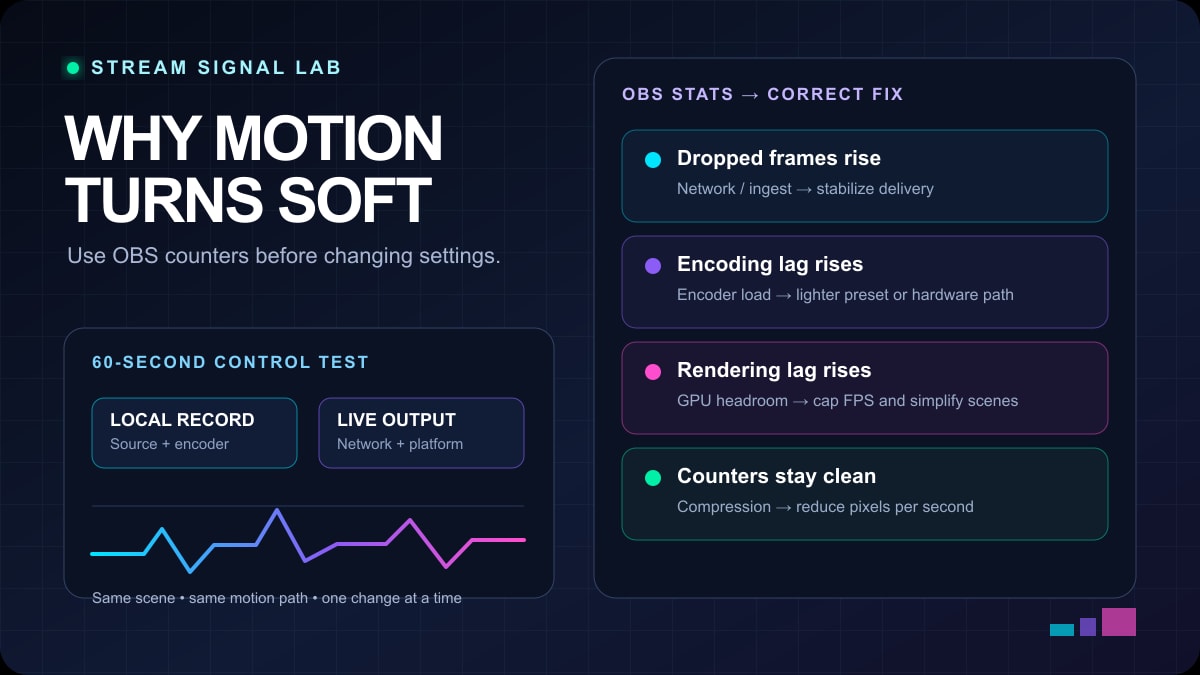
- Record a 60-second local test using your normal scene and fast movement.
- Make a short private or test broadcast using the same scene.
- Open View → Stats in OBS while testing.
- Look separately at Dropped Frames (Network), Skipped Frames Due to Encoding Lag, and Frames Missed Due to Rendering Lag.
- Compare the local recording, OBS preview, live player, and resulting VOD.
- Local recording is clear, stream is blurry: investigate streaming bitrate, resolution, service limits, or network stability.
- Recording and stream are both blurry: inspect encoder and recording settings, scaling, and source quality.
- Dropped frames rise: the connection cannot reliably sustain the configured bitrate.
- Encoding lag rises: the selected encoder or preset is overloaded.
- Rendering lag rises: OBS is not getting enough GPU rendering time.
Fix 1: reduce pixels per second
When bitrate is constrained, 1080p60 is not automatically the best-looking choice. Test a smaller output such as 1664×936, 1600×900, or 1280×720, or switch from 60 to 30 fps. A lower output gives the encoder fewer pixels to describe in every second and can preserve more detail during motion.
Change the Output (Scaled) Resolution under Settings → Video. Keep the base canvas appropriate for your scene, and avoid scaling the same source multiple times through nested transforms and output rescaling.
Fix 2: set a sustainable bitrate
Use Twitch's current broadcasting guidance and the settings available for your account instead of copying a number from an old tutorial. Test the connection at the time of day you normally stream. Your stable upload capacity—not the speed-plan headline—is what matters.
OBS's current stream connection guide suggests starting around 75% of total upload speed when diagnosing dropped frames, while also staying inside the streaming service's limits. A wired connection is preferable to Wi-Fi for consistent upstream delivery.
If the bitrate indicator fluctuates or network dropped frames increase, try a different Twitch ingest server, reduce bitrate, disable a VPN for a controlled test, and check whether router or “network optimization” software is interfering.
Fix 3: choose an encoder your PC can sustain
OBS generally recommends modern hardware encoders because they move encoding work away from the CPU. On a supported NVIDIA GPU, NVENC is usually the practical first choice for a single-PC gaming stream. x264 can work well when the CPU has substantial unused capacity, especially on a dedicated streaming PC.
Do not choose the slowest preset simply because its name sounds better. Watch the OBS Stats panel during the most demanding game scene. If encoding lag rises, use a faster/lighter preset, cap in-game frame rate to leave system headroom, or switch encoder.
Fix 4: leave GPU headroom for OBS
A game can consume nearly all available GPU resources even while its own frame rate appears fine. OBS still needs GPU time to composite the scene. Cap the game's frame rate, lower the most expensive graphics settings, simplify browser sources and filters, and retest the same scene.
Rendering lag is not fixed by increasing upload bitrate. Treat the OBS counters as separate signals.
Fix 5: inspect the source and scaling path
- Match a webcam's configured resolution and frame rate to what the device reliably outputs.
- Avoid enlarging a low-resolution source beyond its native detail.
- Check whether a browser source or capture card is already compressed.
- Use one deliberate downscale rather than repeated source, canvas, and output rescaling.
- Verify that the local source is sharp before troubleshooting Twitch delivery.
A controlled testing method
Change one variable at a time and use the same 60-second movement path:
- Save your current OBS profile and scene collection.
- Run a baseline test and record Stats-panel counters.
- Lower output resolution while keeping bitrate and encoder unchanged.
- If needed, restore resolution and test 30 fps.
- Then test the encoder or preset.
- Only after those tests, adjust bitrate within stable connection and service limits.
This method shows which change helped. Changing resolution, bitrate, preset, server, and frame rate simultaneously makes the result difficult to reproduce.
What not to do
- Do not assume a higher resolution always produces a sharper stream.
- Do not exceed platform guidance just because a forum comment says the limit is optional.
- Do not diagnose network dropped frames as an encoder-quality problem.
- Do not disable security software permanently; use a temporary controlled test and restore protection.
- Do not promise perfectly clean high-motion footage at a constrained bitrate.
Frequently asked questions
Why is my Twitch stream clear until I move?
Fast movement creates much more changing visual information. At the same fixed bitrate, the encoder discards more detail and compression becomes visible.
Should I stream at 720p instead of 1080p?
For high-motion content and limited bitrate, 720p can look cleaner in motion. Test it against your actual scene rather than choosing resolution by label alone.
Will more bitrate always fix the blur?
No. It will not fix encoding lag, rendering lag, a poor source, repeated scaling, or unstable delivery. It must also remain sustainable and within current Twitch guidance.
Why does my local recording look better?
A local recording can use a higher or quality-targeted bitrate and does not travel through a live connection. That comparison usually points toward live bitrate, platform, or network constraints.
Where can I see Twitch-side delivery problems?
Use Twitch's Broadcast Health guide and tools, together with OBS Stats and logs. These views help separate encoder, local network, ingest, and playback symptoms.