Quick answer: “TikTok views” is not one universal metric. A public video count, the total views in an analytics report, unique viewers, paid video views, and Creator Rewards qualified views answer different questions. TikTok's current first-party documentation does not publish a universal one-second rule for the public organic counter, so this guide does not repeat that common claim as fact.
Editorial update: this page was substantially rewritten on July 24, 2026 after reviewing TikTok's current creator, advertising, developer, recommendation, search, monetization, and fake-engagement documentation. The former view sellers, affiliate links, prices, “safe package” advice, fixed success benchmarks, and unsupported testing claims were removed. Stream Mentor reviewed the documented metrics and workflows; we did not buy views, run a new paid campaign, or claim access to TikTok's private counting systems.
What does a TikTok view mean?
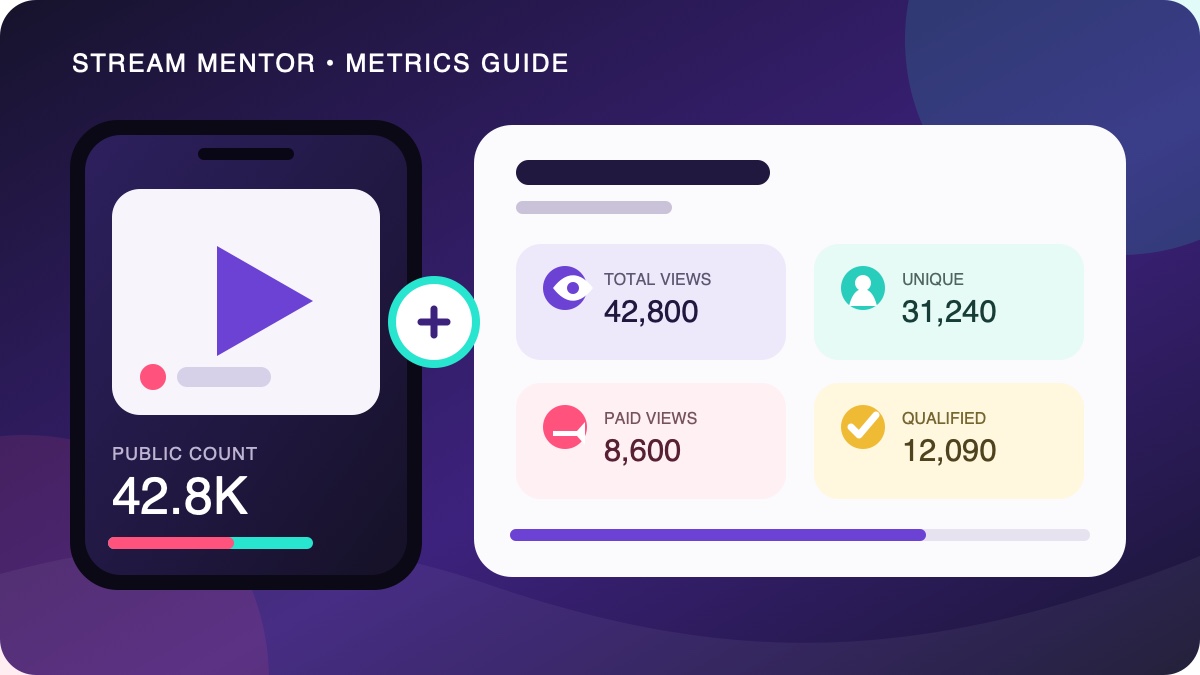
The answer depends on where you see the word view. TikTok uses related labels across the public app, TikTok Studio, Creator Rewards, Promote, Ads Manager, TikTok One, and developer tools. Those labels should not be treated as interchangeable.
| Metric or surface | What it tells you | What it does not prove |
|---|---|---|
| Public video view count | The view count TikTok displays for a public post | How many distinct people watched, how long they watched, or whether a business goal was achieved |
| Total video views | The number of times a report says a video or project was watched | The number of unique viewers |
| Unique viewers | The number of distinct viewers in a reporting surface that provides this metric | That every viewer completed the video or took another action |
| Organic video views | Views attributed to non-paid distribution in a report that separates delivery types | That the views came only from the For You feed or that every view qualifies for rewards |
| Paid video views | Views attributed to paid delivery, such as Spark Ads, in the relevant reporting product | Organic demand or future unpaid distribution |
| Creator Rewards qualified views | A narrower set of eligible, unique For You feed views used by the Creator Rewards Program | The public total, every view in Studio, or a fixed amount of earnings |
| Post view history | A limited feature that may show certain accounts that viewed a recent post | A complete identity list for every number in the public counter |
TikTok's Display API video-object documentation exposes a view_count field as the number of times a video has been viewed. TikTok's TikTok One reporting definitions go further by distinguishing total, organic, paid, and unique views. The most accurate interpretation therefore begins with the name of the product and field—not with a definition copied from a different dashboard.
Does TikTok count a view after one second?
Do not use “one second” as a universal current rule unless TikTok documents it for the exact metric you are discussing. At the time of this review, TikTok's public creator and developer documentation describes video views but does not state a universal one-second threshold for the public organic post counter.
TikTok does publish precise definitions for several advertising metrics. Its current video play metrics guide defines an ad “video view” as a play that starts within an impression session. It separately defines 2-second views, 6-second views, completion milestones, and focused-view products. That advertising definition should not be silently converted into a rule for every public, organic, LIVE, search, or rewards metric.
Creator Rewards uses another threshold for another purpose: views lasting less than five seconds are excluded from qualified views. That does not mean every five-second play becomes a qualified view, and it does not establish how the public counter works. The program also applies source, uniqueness, eligibility, and authenticity requirements.
This distinction matters because several prominent marketing guides state that an autoplay, an immediate start, a one-second watch, or every loop always creates another organic view. Those explanations may be based on earlier interfaces, advertising definitions, or undocumented observation. They are not a substitute for a current first-party definition of the exact organic counter.
Total views and unique viewers answer different questions
A total can be larger than the number of people reached because one person can generate more than one viewing event in some contexts. A unique-viewer metric deduplicates people according to the rules of that reporting product. If a dashboard gives you both, use them together:
- Total views describes viewing volume.
- Unique viewers describes the distinct audience measured by that product.
- Views per unique viewer, calculated as
total views ÷ unique viewers, can provide context about repeat viewing, but it cannot explain why a repeat occurred.
For example, a tutorial may be replayed because people need to repeat a step, while a short visual may loop before someone swipes. The same ratio can reflect very different behavior. Pair it with the content's purpose, average view time, completion information, comments, and downstream actions where those fields are available.
TikTok One explicitly defines total video views as the total number of times a video was watched and unique viewers as distinct viewers. It also warns through its product structure that reporting is context-specific. A metric available in a TikTok One project is not necessarily shown to every personal creator in the same way.
Organic views, paid views, and impressions are not the same
An impression describes an opportunity in which content or an ad was displayed under that product's rules. A video view describes a play under a view definition. A paid view attributes that play to advertising delivery. These numbers can differ, and none should automatically be presented as organic reach.
TikTok One currently defines:
- Organic video views as views acquired through organic delivery rather than Spark Ads.
- Paid video views as views acquired through Spark Ads.
- Total video views as total times the project or video was watched.
- Unique viewers as distinct viewers who watched the video or at least one video in the project.
If you use TikTok's official Promote tool or Spark Ads, record the campaign dates, objective, audience, and spend. Compare paid delivery with the relevant organic period instead of calling the entire public number “organic growth.” A paid view can still come from a real person, but it was acquired through paid distribution and should be evaluated against the campaign goal.
Creator Rewards qualified views are a narrower total
The Creator Rewards Program does not pay for every number displayed on a video. TikTok's current rewards documentation says eligible videos begin collecting rewards after reaching 1,000 qualified For You feed views.
For this program, TikTok describes qualified views as legitimate, unique views of an eligible video from the For You feed. Its published exclusions include:
- fraudulent views;
- paid views;
- promoted views;
- artificial views;
- views from people who marked the video as not interested; and
- views lasting less than five seconds.
The video and creator must also meet the program's current eligibility rules. A public total of 20,000 views can therefore produce far fewer qualified views without indicating that the public counter is broken. The two numbers have different jobs.
TikTok defines RPM as the average rewards collected for every 1,000 qualified views, not every 1,000 public views. TikTok also lists multiple inputs to rewards, so a fixed “pay per view” figure copied from another creator, country, or month is not a reliable forecast.
Where to check TikTok views and viewer information
TikTok's TikTok Studio guide describes four analytics areas: Overview, Content, Viewers, and Followers. It also says creators can manage posts and see performance metrics such as views, likes, and shares. The exact fields and date ranges available can vary by account, region, product version, post type, and eligibility.
- Open TikTok Studio. In TikTok, go to your profile, open the menu, and choose TikTok Studio, or use the standalone app or supported web tools available to your account.
- Start with Content. Select the specific post instead of judging the account from one aggregate total.
- Confirm the date range. A seven-day account chart and a lifetime post count answer different questions.
- Write down the exact field labels. Keep “views,” “viewers,” “paid,” “qualified,” and “search” separate.
- Record campaign periods. Mark any dates when Promote, Spark Ads, or another official campaign was active.
- Export or screenshot the baseline. Preserve enough context to compare the same metrics after the next editorial test.
Do not assume that Post view history reveals everyone behind the total. TikTok's Post view history documentation limits the feature by post age, account eligibility, follow relationship, settings, and interactions. It is not a complete named ledger of all viewers. Our separate TikTok viewer guide explains the privacy and view-history distinctions in more detail.
How to analyze a TikTok video's views without invented benchmarks
There is no universal number at which a post becomes “good,” “viral,” or ready to monetize. An account with a narrow local audience and a high-value action has a different success condition from a broad entertainment account. Compare the post with a relevant baseline and a declared goal.
1. State the job of the video
Choose one primary outcome before reading the chart: explain a topic, reach non-followers, answer a search, earn relevant profile visits, generate qualified leads, or support an eligible rewards strategy. A view total alone cannot show whether the intended outcome happened.
2. Compare like with like
Compare posts with a similar topic, format, duration, audience, publishing context, and amount of paid distribution. Comparing a promoted product post with an unpromoted personal story can create a dramatic but meaningless conclusion.
3. Read volume and depth together
Use the fields your account actually provides. Views show volume; unique viewers show audience size; average view time or completion information shows viewing depth; comments, shares, favorites, follows, clicks, or conversions show different kinds of response. Do not invent a “perfect” percentage that applies to every length and purpose.
4. Check where discovery came from
When TikTok exposes source or search information, separate For You, search, profile, following, paid, and other discovery contexts. A search answer may grow slowly but remain useful, while a trend-led post can peak quickly. Different sources call for different editorial decisions.
5. Make one defensible change
Change one meaningful element in the next post: the question answered, opening explanation, example, structure, on-screen clarity, caption, or audience. If every variable changes at once, the result cannot tell you which decision helped.
6. Judge a series, not one upload
One post can be affected by topic demand, timing, audience fit, eligibility, or ordinary variation. A small series built around the same audience problem provides a more useful comparison than repeatedly deleting and reposting one video.
Why TikTok views can be low or fluctuate
A low number does not prove a hidden penalty, and a high number does not prove quality. Use an evidence-based sequence:
| What you observe | Check first | Avoid concluding |
|---|---|---|
| The post has almost no views | Visibility, upload status, processing, account or post notices, and whether the post can be viewed from another normal account | “I am definitely shadowbanned” |
| Views rose, then flattened | Comparable posts, viewer response, discovery source, topic demand, and whether paid delivery ended | “TikTok caps every account at a fixed number” |
| Public views are much higher than qualified views | Creator Rewards source, uniqueness, watch-duration, promotion, authenticity, and video eligibility rules | “TikTok deleted legitimate earnings” |
| Views increased but business results did not | Audience fit, offer, profile or landing-page path, clicks, qualified actions, and paid targeting | “More views will automatically fix conversion” |
| Search views are weak | The actual query, how directly the video answers it, caption and spoken context, and Creator Search Insights | “Adding more unrelated hashtags guarantees search reach” |
| A post or account is ineligible for recommendation | The notice, cited policy, affected content, and the official appeal route | “A paid service can remove the restriction” |
TikTok's current recommendation explanation groups major factors into user interactions, content information, and user information. For the For You feed, interactions such as watching in full or skipping may be important; for Search, how well content matches the query can be weighted heavily. TikTok also says factor importance can change. That is evidence against any universal formula promising a fixed view count after a fixed set of hashtags or actions.
Legitimate ways to reach more relevant viewers
- Research a real question. TikTok's Creator Search Insights surfaces frequent searches, related searches, and possible content gaps. Use the findings as research, not a guarantee.
- Answer the topic clearly. Show what the post is about early enough for the intended viewer to make an informed choice. A misleading shock opening may create a play without delivering useful attention.
- Use accurate context. Spoken words, on-screen text, captions, sounds, and hashtags should support the same topic. Stuffing a trending term into unrelated content weakens relevance.
- Study skips and useful responses. Where analytics are available, use viewing behavior and meaningful comments to find unclear sections or unanswered questions.
- Create a connected series. Cover the next genuine question rather than producing near-duplicate posts solely to increase upload volume.
- Collaborate for audience fit. Work with creators or communities whose viewers have a real reason to care about the subject; do not coordinate fake plays or engagement swaps.
- Use official paid distribution for a paid goal. Promote or Ads Manager can buy visibility, but label and measure it as advertising.
Do not buy views or use automation to make a counter look larger. TikTok's Integrity and Authenticity rules prohibit services that artificially increase engagement and the use of bot accounts or automation to drive traffic. Our TikTok viewbot safety guide covers the enforcement and account-security steps if artificial traffic has already been used.
Frequently asked questions
How many TikTok views is good?
There is no universal good number. Define the audience and outcome, then compare the post with similar posts on the same account using the same delivery type and date window. A small number of relevant viewers can be more valuable than a large unrelated paid audience.
Do repeat watches count as more TikTok views?
TikTok documents repeat behavior differently by product. Its current ad documentation says replays within an impression session are excluded from ad video views, while leaving and returning can create a new impression session. TikTok does not publish that as a universal rule for every public organic counter, so avoid an absolute answer detached from the metric.
Can I see exactly who viewed my TikTok?
Not for every number in the public total. Post view history can show certain eligible accounts for recent posts under specific settings, and Stories have separate rules. Aggregate viewer analytics do not create a complete identity list.
Why are qualified views lower than total views?
Creator Rewards qualified views must be unique, legitimate For You feed views of an eligible video and follow the program's current exclusions. Paid, promoted, artificial, fraudulent, disliked, and under-five-second views are among the views TikTok says it excludes.
Do TikTok Promote views count toward Creator Rewards?
TikTok lists promoted and paid views among the exclusions from Creator Rewards qualified views. Keep the campaign report and rewards report separate.
Does a high view count make the next video go viral?
No documented rule guarantees that result. TikTok says recommendations are personalized and consider multiple factors whose importance can change. A strong post can teach you about audience interest, but its public counter is not a voucher for future reach.
Should I delete and repost a low-view video?
Not automatically. First check visibility, notices, eligibility, topic fit, and analytics. If the idea is useful but the execution is unclear, create a genuinely improved version rather than repeatedly uploading the same file to chase a different counter.
Sources and review scope
- TikTok for Developers: Video Object and
view_count. - TikTok Help Center: TikTok Studio.
- TikTok Business Help Center: TikTok One Project Reporting.
- TikTok Business Help Center: Video play metrics.
- TikTok Help Center: How Creator Rewards work.
- TikTok Help Center: How TikTok recommends content.
- TikTok Help Center: Creator Search Insights.
- TikTok Help Center: Post view history.
- TikTok Community Guidelines: Integrity and Authenticity.
All sources above were checked on July 24, 2026. TikTok can change metric names, program eligibility, interfaces, reporting windows, and counting rules. Use the exact label and live definition in your own product surface when it differs from this guide.