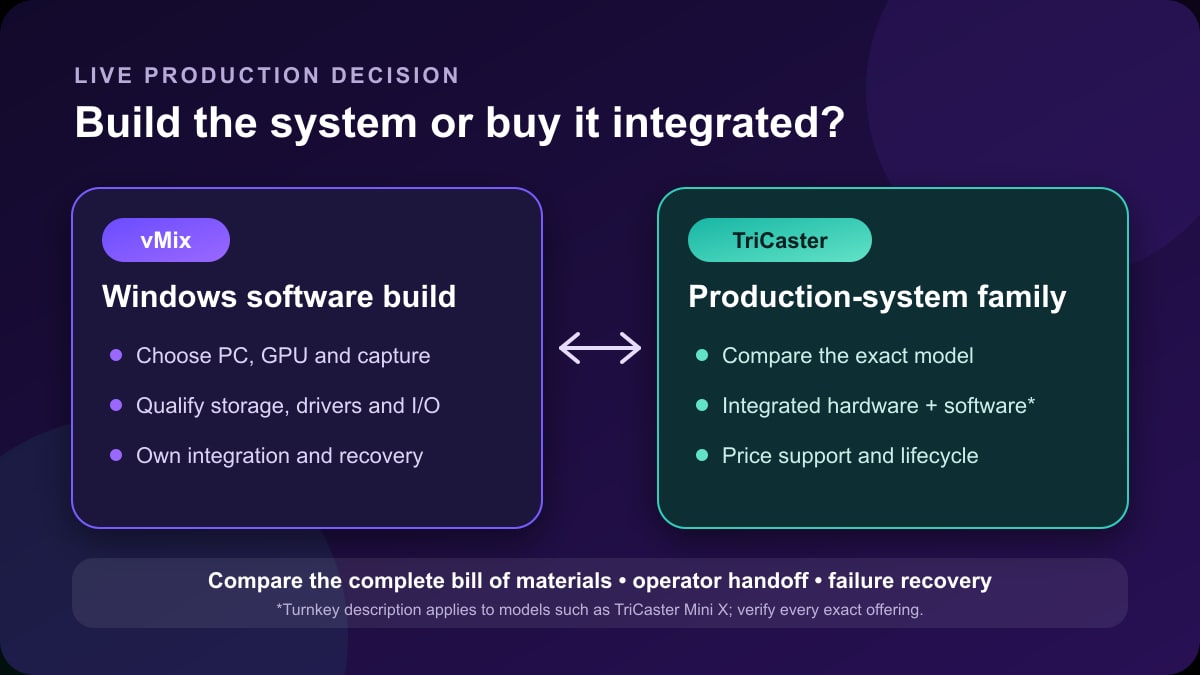
Quick answer: vMix and TriCaster are not two interchangeable software downloads. vMix is Windows-based live-production software; you choose, build, validate, and support the PC, capture hardware, storage, networking, and controls around it. TriCaster is a family of production systems. For example, Vizrt describes the TriCaster Mini X as a turnkey system with hardware and software preconfigured together.
Practical choice: choose vMix when you want a configurable Windows workflow, can qualify the complete computer and I/O chain, and value transparent software pricing. Shortlist a current TriCaster when consistent deployment, an integrated production environment, vendor or reseller planning, and easier operator handoff are worth more than choosing every PC component yourself. Neither is automatically cheaper or more reliable after the complete system is counted.
Checked July 24, 2026: Stream Mentor rebuilt this comparison from the current vMix download, edition, and supported-hardware pages and Vizrt's current TriCaster family and Mini X pages. The former article treated TriCaster 8000, 400, and 40 as the current lineup, compared a software license with an appliance by headline price, and made unsupported performance recommendations. Those sections were removed. We did not run a controlled production benchmark or accept payment from either company.
vMix vs TriCaster at a glance
| Decision area | vMix | TriCaster |
|---|---|---|
| What you are selecting | Windows live-production software in several editions | A product family; models and deployment types must be compared individually |
| Computer | You supply or commission a qualified Windows PC | A turnkey model such as Mini X includes optimized, preconfigured hardware and software |
| I/O | Depends on the PC, capture devices, drivers, network sources, and edition | Depends on the exact TriCaster model, its physical connections, and network workflow |
| Pricing visibility | Public software-edition prices; the complete PC system costs extra | Mini X directs buyers to contact sales; request an itemized system quote |
| Customization | Broad choice of PCs, GPUs, capture products, controllers, and storage | More standardized system boundary, with expansion depending on model and supported ecosystem |
| Validation owner | The buyer or integrator validates the assembled chain | The integrated system reduces PC-component selection, but the buyer still validates cameras, audio, network, destinations, and recovery |
| Updates | vMix application plus Windows, GPU, capture, controller, and device software | Model-specific TriCaster software and any connected device or network updates |
| Best fit | Teams that want a flexible Windows build and can own its engineering | Teams that value a defined production system, repeatable operation, and an integrator or vendor path |
The useful comparison begins with responsibility, not a feature count. A vMix license can look inexpensive because the computer, capture cards, converters, storage, monitors, controls, and engineering time sit outside the license. A TriCaster quote can look expensive because more of the production system may be inside the purchase. Put both options on the same bill of materials before deciding.
What vMix is in 2026
vMix's current download page lists vMix 29 for Windows and a free 60-day trial for new users. The installer also includes vMix Social, GT Title Designer, and Desktop Capture. vMix explicitly calls the application Windows-based software only, so this is not a native macOS choice.
The current vMix comparison table lists five commercial paths:
| Edition | Price shown July 24, 2026 | Published positioning to verify |
|---|---|---|
| Basic HD | $60 USD lifetime license | Four total inputs, three camera/NDI inputs, up to 1920 × 1080, and one overlay channel |
| HD | $350 USD lifetime license | Up to 1920 × 1080, more inputs, and eight overlay channels |
| 4K | $700 USD lifetime license | Up to 4096 × 2160 and additional higher-tier capabilities |
| Pro | $1,200 USD lifetime license | Top perpetual edition; compare replay, calls, recording, and output rows against the exact show |
| MAX | $50 USD per month | Subscription path with updates while subscribed |
vMix says its lifetime-license editions include free updates for the first 12 months, while MAX receives updates while subscribed. “Lifetime license” should not be read as unlimited future major-version updates. Check the current upgrade policy and comparison rows at purchase time.
Do not select an edition from resolution alone. Count live cameras and network inputs, simultaneous streams, recorders, video calls, replay channels, external outputs, mix inputs, audio buses, overlays, and any feature that must remain active at the same time. A feature appearing somewhere in the product family does not mean it is present in Basic HD or HD.
The vMix PC is part of the product you are designing
vMix's supported-hardware page publishes Windows 10 or 11, a 2 GHz quad-core processor, 4 GB DDR4, a DirectX 10.1-compatible dedicated graphics card, and 1920 × 1080 display as minimums. Its recommended column lists a 3 GHz-or-faster Core i7, 8 GB DDR4, SSD storage, and a dedicated Nvidia GPU with at least 2 GB of memory.
Those are entry and reference figures, not a promise that a minimum-spec computer can run your maximum show. The same page says graphics-card speed affects how many HD cameras, inputs, recordings, streams, and outputs are possible. Codec, resolution, frame rate, replay, recording format, browser inputs, calls, graphics, capture drivers, and thermal behavior also change load.
A production vMix build therefore needs a workload test. The trial is valuable because it lets the buyer reproduce the actual show before buying the license. Test the same camera count, formats, graphics, remote guests, recording destinations, stream outputs, and controller actions—not an empty project with one webcam.
What TriCaster means in 2026
“TriCaster” is not one fixed appliance or one current specification. Vizrt's TriCaster family update center lists resources for Mini S, Mini Go, Mini X, Mini 4K, TC410 Plus, TC1, 1 Pro, 2 Elite, Vizion, Vectar, TriCaster Now, and older products. Presence in a support or update center does not by itself prove that every model is newly available in every country. Confirm active sale, support term, software entitlement, and lifecycle status with Vizrt or an authorized reseller.
The old Stream Mentor article centered its buyer advice on TriCaster 8000, 400, and 40. Vizrt now groups TriCaster 8000, 860, 460, 410, Mini, and Mini SDI under its older Standard Edition resource section. Historical documentation can help an existing owner, but it is not a sound current-new-system shortlist.
TriCaster Mini X shows the turnkey difference
Vizrt describes Mini X as a complete all-in-one production system with hardware and software, optimized performance, and preconfigured settings. Its product page describes video switching, media playback, virtual sets, graphics, recording, and streaming, with direct use of off-the-shelf HDMI devices and an NDI-centered design.
That integration changes who makes some early engineering decisions, but it does not eliminate system design. A buyer still needs to verify the exact physical input and output count, signal formats, converters, audio routing, NDI network capacity, camera control, record channels, graphics, remote contributors, control surface, support plan, and backup path for the chosen model.
Mini X's public page uses a contact-sales path rather than a simple global checkout price. Ask for an itemized quote that identifies the model, hardware, control surface, included software or services, support term, training, shipping, taxes, required accessories, and optional modules. Compare that figure with a complete vMix build, not with a vMix license alone.
Feature parity is a workflow question
Camera and network inputs
Write down every source and its transport: HDMI, SDI, USB, NDI, SRT, browser, file playback, remote guest, phone, or another format. Then record resolution, frame rate, embedded audio, cable distance, and whether the source must be isolated or recorded. “Supports 4K” does not answer how many simultaneous 4K sources, which connection accepts them, or what else can run at the same time.
For vMix, match the edition, capture device, PCIe or Thunderbolt topology, GPU, and drivers. vMix maintains specific supported-hardware categories for capture products, controllers, PTZ cameras, tally, and SRT. For TriCaster, use the exact model's current technical specification and ask the reseller to confirm the proposed signal path in writing.
Graphics, playback, and automation
List the graphics that must be edited live, data sources, media playback, virtual sets, lower thirds, scoreboards, and automation cues. Build representative templates and have the actual operators update them under show timing. A demonstration reel proves that a result is possible; it does not prove that your team can edit, recall, and recover it during a live event.
If an external automation system, MIDI surface, Stream Deck, tally controller, API, or newsroom tool is required, verify the specific integration version. “Customizable” is not enough. Test each action, state feedback, reconnect behavior, and what happens after an application or device restart.
Recording and replay
Count program recording, isolated camera records, clean feeds, audio tracks, proxies, and replay angles separately. Define the recording codec, bitrate, continuous duration, and delivery deadline. Storage capacity alone is not throughput, and a fast drive specification does not establish that the entire system can record, replay, stream, and render graphics simultaneously.
Sports buyers should compare replay only after writing the real operator workflow: number of angles, ingest resolution and frame rate, tagging, playlists, playback channels, export format, controller, and storage rollover. Select the exact vMix edition or TriCaster configuration that supports that workflow; do not infer it from a family-level product name.
Remote guests and distribution
Define the number of remote contributors, return feeds, mix-minus paths, talkback, waiting-room or producer workflow, and failure fallback. For distribution, list every platform, resolution, encoder, backup destination, and whether a clean output must also go to a recorder or venue screen. Test under the venue's real upstream bandwidth and firewall conditions.
Total-cost worksheet
Use the same time horizon—often three to five years—for both options. Leave a line at zero only after confirming it is genuinely included.
| Cost area | vMix build | TriCaster proposal |
|---|---|---|
| Core software or system | Edition, upgrades after included period, or MAX subscription | Exact model, software entitlement, and any subscription |
| Compute | Qualified PC, GPU, power supply, cooling, Windows, and rack or case | Included system plus any external compute required |
| Video I/O | Capture cards or devices, converters, cables, and distribution | Built-in ports plus converters, I/O modules, and expansion |
| Storage | OS, media, recording, replay, backup, and archive drives | Included and external storage, archive, and replacement plan |
| Control | Keyboard, displays, control surface, tally, and custom programming | Control surface, displays, tally, and model-specific options |
| Network | Switches, adapters, VLAN work, NDI capacity, monitoring, and cabling | The same network costs; an NDI-centered system still needs a designed network |
| Support | Integrator time, spare PC or parts, images, driver qualification, and internal labor | Vendor or reseller support, warranty extension, loaner or spare plan, and internal labor |
| People | Configuration, documentation, training, show operation, and recovery drills | Configuration, documentation, training, show operation, and recovery drills |
A custom vMix system can be cost-effective when the team already has suitable equipment and engineering skill. A standardized TriCaster can reduce integration and handoff effort in another organization. Conversely, an underspecified vMix PC or an overbought TriCaster can make either path poor value. Price the operational requirement, not the brand.
Which should you choose?
Choose vMix when
- the production team is comfortable maintaining a Windows computer and qualifying drivers;
- you want to choose capture, GPU, storage, controllers, and upgrade timing;
- the required edition and complete hardware build fit the budget;
- you can reproduce the show during the 60-day trial;
- you can maintain a system image, configuration backup, tested spare path, and build documentation.
Shortlist a TriCaster when
- you want a defined production system rather than assembling a Windows workstation yourself;
- repeatable deployment and operator handoff matter across a venue, school, church, studio, or events team;
- an integrator or reseller will design and support the complete proposal;
- the exact model provides the required I/O and workflow without unclear add-ons;
- the itemized quote, lifecycle, support, training, and recovery plan justify the total cost.
Do not choose either yet when
The team cannot state its source count, formats, outputs, recording requirement, remote workflow, graphics, network constraints, operators, and recovery target. In that case, the next step is a one-page production specification and a proof of concept—not a purchase.
Proof-of-concept and failure checklist
- Build the maximum show: use the highest simultaneous camera, remote, graphics, playback, recording, replay, and output load expected in year one.
- Use production formats: match camera resolution, frame rate, codec, cable type, network transport, and audio channel layout.
- Run for real duration: a five-minute demo will not reveal a storage, heat, memory, sync, or reconnect issue in a three-hour event.
- Test the network: reproduce NDI, SRT, remote calls, control traffic, internet delivery, and other venue traffic together.
- Interrupt one dependency at a time: disconnect a camera, network source, controller, destination, and noncritical display; document what the operator sees and how recovery works.
- Fill storage safely: validate warning behavior, rollover, file integrity, transfer time, and space required before the next show.
- Restart: time a clean reboot, project restore, signal reacquisition, streaming restart, and control-surface recovery.
- Use a second operator: hand only the runbook to someone who did not build the system. Record every missing instruction.
- Verify support: place a nonurgent test request or review the exact support path, hours, entitlement, escalation, and replacement process.
- Prove the backup: test the spare encoder or reduced emergency scene instead of merely listing it in the budget.
Keep the validated software, firmware, driver, Windows, and plugin versions with the show documentation. Do not apply a production-day update because a newer version exists. Review release notes, clone or back up the working configuration, test offline, and keep a rollback path.
Frequently asked questions
Is vMix better than TriCaster?
Not universally. vMix offers configurable Windows software with public edition pricing; a TriCaster such as Mini X offers a preconfigured hardware-and-software production system. The better option is the one that passes the exact workflow, operator, support, recovery, and total-cost test.
Is TriCaster software or hardware?
TriCaster is a family, so check the exact offering. Vizrt explicitly describes Mini X as a turnkey system containing hardware and software. Its family resource center also lists multiple current and historical models and deployment types. Do not apply one model's specification to every TriCaster.
Does vMix work on Mac?
vMix's current download page says it is Windows-based software only. Do not plan a production around an unsupported assumption that a native Mac edition exists. If the organization requires macOS, compare software that officially supports that operating system.
How much does vMix cost?
On July 24, 2026, vMix listed Basic HD at $60, HD at $350, 4K at $700, and Pro at $1,200 as lifetime-license editions, plus MAX at $50 per month. The PC, capture, storage, controls, network, support, and upgrades outside the included update period are separate costs.
How much does a TriCaster cost?
There is no responsible single number for a product family. The Mini X page uses a contact-sales path. Request a dated, itemized quote for the exact model and complete system, including control, I/O, storage, support, training, shipping, and necessary options.
Is an old TriCaster 40, 400, or 8000 still useful?
Possibly for an existing supported workflow, but it is not equivalent to a current new-system recommendation. Vizrt places models including the 8000 and 410 in its older Standard Edition resource section. Before buying used hardware, verify lifecycle, current software eligibility, account or license transfer, parts, support, supported formats, physical condition, and a return path.
Sources and review scope
- vMix: current download and release-notes page for the Windows-only application, current vMix 29 build, included applications, and 60-day trial.
- vMix: edition comparison and purchase page for July 24, 2026 pricing, license types, update periods, and edition rows.
- vMix: supported-hardware and system-requirements page for minimum, recommended, GPU, capture, controller, camera, tally, and network-hardware context.
- Vizrt: TriCaster family product-update center for the current family resource list, exact models, software downloads, guides, and historical Standard Edition grouping.
- Vizrt: TriCaster Mini X product page for its turnkey hardware-and-software description, production functions, HDMI-device and NDI positioning, and contact-sales route.
Primary manufacturer documentation and the visible comparison landscape were reviewed on July 24, 2026. Stream Mentor did not benchmark a vMix PC against a TriCaster, quote a private reseller proposal, or claim hands-on reliability. Specifications, versions, prices, support status, and regional availability can change; repeat the bill-of-materials and proof-of-concept checks before purchase.