Quick answer: for a second screen used mainly for chat, OBS controls, alerts, and a browser dashboard, start with a 23.8- or 24-inch 1920 × 1080 IPS monitor that has the input your computer can actually drive, a stable stand, and either built-in pivot adjustment or a VESA mount if you want portrait mode. A 60–100 Hz model is normally enough for those mostly static tools. Choose a 27-inch 2560 × 1440 display when you also want comfortable editing or several full-size windows, and consider a portable monitor only when mobility matters more than stand quality and screen area.
Compatibility comes before the monitor: confirm the exact computer or graphics card supports another independent display at the resolution and refresh rate you intend to use. A basic HDMI splitter duplicates one signal; it does not create the extended desktop a streamer needs. Laptop USB-C ports also vary, so the connector's shape alone does not prove that it carries video.
Editorial update: Stream Mentor completely rebuilt this guide on July 24, 2026. The former eight-product ranking contained old or discontinued models, inaccurate resolution and connection advice, affiliate links, and first-person testing and ownership claims that the available editorial record could not support. Those recommendations were removed. This replacement is a source-based selection and setup guide with a small current shortlist verified against each manufacturer's specifications. Stream Mentor did not hands-on test these monitors, the examples are not a measured performance ranking, and no manufacturer or retailer paid for inclusion.
Choose the screen for the job it will do
| Secondary-screen job | Sensible starting profile | Prioritize | Usually unnecessary |
|---|---|---|---|
| Chat and stream controls | 23.8–24 inches, 1920 × 1080, IPS, 60–100 Hz | Readable text, VESA or pivot support, thin enough bezels, correct input | 4K, HDR, extreme refresh rates, gaming branding |
| OBS plus several browser tools | 27 inches, 2560 × 1440, IPS | More usable desktop area, height adjustment, dependable scaling | A curved panel or competitive-gaming response-time claim |
| Portrait chat or moderation feed | 24-inch 1080p or 24–27-inch 1440p display with pivot/VESA support | A stand or arm that safely rotates, cable clearance, viewing angles | A factory portrait label if the monitor has a standard compatible mount |
| Laptop or travel setup | 13–16-inch portable 1080p display | Verified video input, power requirements, a usable cover or stand, total packed weight | Desktop-size speakers and a high refresh rate for a control screen |
| Editing and color-sensitive preview | 27-inch 1440p or 4K display documented for the required color space | Manufacturer color specifications, calibration controls, uniformity, suitable connections | Assuming an “HDR” badge makes the screen accurate |
| Lowest-cost upgrade | A working monitor or TV you already own | Compatible output, readable scaling, safe placement, acceptable latency for controls | Buying a new display before testing the workflow |
These are starting profiles, not a universal product ranking. Desk depth, eyesight, operating-system scaling, the primary monitor, available ports, and whether the second screen will ever run games can change the answer. If an existing display can show chat and OBS clearly, reuse it for a week before spending money. That trial reveals whether you need more pixels, portrait rotation, a smaller footprint, or no second monitor at all.
Current second-monitor shortlist by use case
The models below are current examples that match distinct jobs as of this review—not claims that one screen is objectively best. Selection was limited to models with a live manufacturer page and specifications that directly support the stated use case. We did not evaluate panel uniformity, input latency, response-time behavior, defect rates, or long-term reliability. Check regional availability and the exact model code before buying.
| Use case | Current model example | What the maker documents | Important limitation |
|---|---|---|---|
| Simple 24-inch control screen | Dell Pro 24 Plus P2425H | 23.8-inch 1920 × 1080 IPS panel, up to 100 Hz, HDMI and DisplayPort, height/tilt/swivel/pivot stand | Its downstream USB-C port is for data and limited power, not the laptop video input found on the HE model |
| Portrait chat with extra vertical room | HP Series 5 Pro 524pn | 24-inch 1920 × 1200 IPS panel, up to 100 Hz, pivot and 150 mm height adjustment, HDMI and DisplayPort | It is a 16:10 office display, not a measured recommendation for gaming motion or HDR |
| Roomier 27-inch OBS workspace | Dell Pro 27 Plus QHD P2725D | 27-inch 2560 × 1440 IPS panel, up to 100 Hz, height/tilt/swivel/pivot stand, HDMI and DisplayPort | The USB-C connector listed in its hub is downstream data; choose a video-capable USB-C model if one-cable laptop input is required |
| One-cable USB-C laptop desk | Dell Pro 27 Plus QHD USB-C Hub P2725DE | 27-inch 2560 × 1440 at up to 100 Hz, USB-C DisplayPort Alt Mode with up to 90 W power delivery, USB hub, DP-out MST, ergonomic stand | The laptop must support video over USB-C; power delivery and a DP-out socket do not override the computer's display-count limits |
| Editing plus stream controls | ASUS ProArt PA278CGV | 27-inch 2560 × 1440 IPS panel, 100% sRGB and 95% DCI-P3 claims, factory calibration report, USB-C video with 90 W power delivery, pivot stand | Manufacturer calibration specifications are not our own measurement; verify the required color workflow and consider independent instrument testing |
| Portable chat or travel display | ASUS ZenScreen MB16AHV | 15.6-inch 1920 × 1080 IPS panel at 60 Hz, two USB-C DP Alt Mode inputs, Mini HDMI, sleeve and tripod socket | Its small screen, folding support, 250-nit maker rating, and separate power/cable requirements are compromises versus a desktop monitor |
These links go to manufacturer pages rather than affiliate retailers. Treat the table as a compatibility-oriented shortlist to investigate, then compare warranty terms and independent measurements for the exact unit. A less expensive current monitor with the right input and stand can be the better second screen for a chat-only workflow.
Do streamers need two monitors?
No. A second display does not improve the outgoing video by itself, and it is possible to stream from one screen by using OBS docks, keyboard shortcuts, a phone or tablet for chat, or careful window switching. The benefit is operational: the game or presentation can remain on the primary screen while the second screen keeps stream health, chat, scene controls, audio meters, reference notes, and moderation tools visible. If the goal is to show chat inside the broadcast rather than only to the streamer, use the separate Twitch chat overlay guide.
OBS also supports fullscreen and windowed projector outputs for sources, scenes, program, preview, and its built-in Multiview. The OBS Project's projector guide shows how a connected display can carry a normal or custom multiview. That is useful for a production monitor, but it does not mean every beginner should buy a second screen before improving audio, lighting, or stream reliability.
A practical no-cost test is to run a private or local-recording session with the tools you expect to keep visible. Put chat and stream controls on another device or a temporary borrowed display. Note what you repeatedly miss, how often you change scenes, and whether the extra screen actually reduces mistakes. Buy for that observed problem rather than for a generic streamer desk photo.
Check display compatibility before shopping
1. Count independent display outputs
Look at the exact computer, laptop, dock, or graphics-card specification—not just the ports visible in a product photo. A desktop graphics card may have several outputs; a laptop may combine its internal panel with one or more supported external displays. The maximum can depend on the machine model, processor, dock, resolution, and refresh rate.
Windows can only extend the desktop when the hardware presents another independent display signal. Microsoft's current external-monitor troubleshooting guide explicitly warns that a display splitter duplicates the same signal instead of creating two independent signals. If a device has one usable output, Microsoft points users toward a compatible dock or USB display adapter—but the computer and adapter still have to support the intended arrangement.
2. Identify the output and input at both ends
Write down the source port and the monitor input: DisplayPort, HDMI, Thunderbolt, or USB-C are common on current equipment. USB-C describes a connector, not one guaranteed feature set. Verify video support in the computer's technical specifications and verify the monitor's USB-C port is a video input rather than only a data, service, or power connection.
Adapters are directional. A cable marketed for one source-to-display direction may not work in reverse. Also confirm that the cable, adapter, dock, source, and display all support the chosen resolution and refresh rate together. The lowest-capability link can limit the result.
3. Treat Mac display limits as model-specific
Apple's external-display guide tells users to identify the Mac's ports, check the exact model's Display Support or Video Support specification, and obtain the matching cables or adapters. The number of external screens is not safely inferred from the number of USB-C sockets. Check the Mac model and chip before ordering a dock or monitor.
4. Understand DisplayPort daisy chaining
Some compatible DisplayPort systems use Multi-Stream Transport (MST) to carry independent displays from one source through a hub or daisy-chainable monitors. The current DisplayPort FAQ describes MST as DisplayPort's multi-display capability, which is different from a simple mirrored splitter. Support and sufficient bandwidth are required in the source, connection path, and display or hub; do not assume every DisplayPort or USB-C device implements the same topology.
Mac caveat: do not treat a monitor's DP-out/MST claim as proof that a particular Mac can drive the chain. Apple documents external-display limits by exact Mac model, chip, resolution, and refresh rate. Apple also describes supported hubs and display daisy chains over Thunderbolt on current Macs, but says they do not increase the model's maximum display count. Verify the Mac, dock, cable path, and monitors as one supported arrangement.
5. Test the connection before the return window closes
- Connect the display using the final cable, adapter, or dock.
- Choose an extended desktop rather than mirror or duplicate mode.
- Set the monitor's native resolution and a supported refresh rate.
- Restart the computer and reconnect the dock once to test detection.
- Open OBS, chat, the streaming dashboard, and the game or source application together.
- Record locally for at least 15 minutes while switching scenes and moving windows.
- Check text clarity, audio behavior, dropped or lagged frames, cable stability, sleep/wake recovery, and heat around any dock or adapter.
Which specifications matter for a second streaming monitor?
Size and resolution
Screen size and pixel count work together. A 24-inch 1080p panel is a practical baseline for chat, meters, and controls because interface text remains usable without demanding a large desk. A 27-inch 1440p panel provides more workspace for an OBS window beside a browser dashboard. A 27-inch 4K display can show finer detail, but comfortable text may require scaling, and it adds cost and connection requirements that a control screen may not justify.
“2K” is used inconsistently in retail listings. Compare the actual pixel dimensions. For this decision, 1920 × 1080 is Full HD, 2560 × 1440 is commonly called QHD or 1440p, and 3840 × 2160 is 4K UHD. Matching those numbers avoids the previous guide's incorrect statement that 1920 × 1080 was 2K.
Two monitors do not have to share a resolution or physical size. Mixed scaling can make a window change apparent size when dragged between displays, however, so test the arrangement with the apps you use. Similar physical height and pixel density can make side-by-side movement feel more coherent, but they are preferences rather than streaming requirements.
Refresh rate
Refresh rate is how often the display can update each second. Chat, audio meters, dashboards, and scene controls do not need a 240 Hz panel. Sixty hertz is functional; 75–100 Hz can make pointer movement and scrolling look smoother if the complete connection supports it. Pay for a higher rate when the second display will also become a gaming screen or when you have personally found lower-rate motion uncomfortable—not because streaming software requires it.
Windows exposes only the refresh rates supported by the current display path. Microsoft's refresh-rate guide notes that some selectable rates require a resolution change. After setup, confirm both the resolution and rate rather than assuming the advertised maximum is active.
Panel type and viewing angle
IPS is a practical category to compare first for a secondary screen viewed from the side or rotated vertically because many current models specify wide viewing angles. That is not a guarantee of accurate color or a good individual unit. VA and TN models can also work, and their actual contrast, viewing-angle behavior, motion, and uniformity vary by model. Do not select a panel solely from a three-letter technology label or an advertised response time.
Panel technology alone does not prove brightness, uniformity, color accuracy, motion quality, or absence of defects. Compare the manufacturer's specification sheet and trustworthy measurements for the exact model. If accurate grading matters, look for documented color-space coverage, calibration support, and independent instrument testing; this article does not supply that testing.
Stand, pivot, and VESA mounting
Ergonomics often matter more than another performance badge. A height-adjustable stand can align two screens without buying an arm. Pivot support rotates a compatible screen into portrait orientation. A VESA mount gives more placement options, but you must match the monitor's mount pattern and weight with the arm's supported range and install it according to both manufacturers' instructions.
Check cable clearance before rotating. Side-facing connectors and a stand with sufficient swivel are easier to manage than a cable pressed against the desk. A portable monitor's folding cover may save space, but it should hold the screen securely at the viewing angle you will actually use.
Inputs, USB hubs, speakers, and power delivery
One correct video input is more valuable than several ports you cannot drive. Extra inputs help when the display alternates between a streaming PC, work laptop, or console. A built-in USB hub can reduce cable clutter, and USB-C power delivery can charge some laptops, but verify the wattage and video mode in both devices' documentation.
Built-in monitor speakers are convenient for system sounds, not a substitute for monitoring the broadcast mix. Use headphones or the audio path you have tested in OBS. HDMI and DisplayPort can carry audio, and adding a display can cause the operating system to select it as a new default output; verify the selected playback and monitoring devices after connection.
HDR and color claims
HDR is rarely a priority for a chat-and-controls screen. An “HDR compatible” input claim by itself does not establish measured peak brightness, dimming, black level, color gamut, or accuracy. VESA's DisplayHDR program publishes separate certified tiers and tests multiple performance criteria; even a certification tier should be interpreted for the intended workflow rather than treated as a universal quality score. Mixed HDR and SDR displays can also look inconsistent on the desktop. Unless the second screen is a deliberate HDR preview device with a documented workflow, spend first on fit, readability, mounting, and connectivity.
Portrait or landscape for streaming?
Use portrait when the main jobs are a tall chat feed, moderation queue, activity list, notes, or code. More vertical lines remain visible, and the narrow footprint can fit beside a large main display. Confirm the panel remains readable from the off-axis angle created by rotation and that the stand, mount, and cables safely support it.
Use landscape when the screen carries the full OBS interface, Multiview, several docks, a wide timeline, or two windows side by side. OBS's normal 16:9 preview also uses the space more efficiently. There is no need to rotate a monitor just because other streaming setups do.
Try both orientations before final cable management. The operating system can rotate the desktop without physically moving the screen, which lets you inspect window fit first. Then rotate only through the range permitted by the stand or mount; do not turn a fixed stand or unsupported panel by force.
Set up a second monitor in Windows
- Connect and power the display, then open Settings → System → Display.
- Select Identify so the numbered boxes match the physical screens. If the new screen is missing, use Multiple displays → Detect.
- Press Windows + P and choose Extend. Duplicate shows the same desktop and is normally the wrong mode for chat and controls.
- Drag the display boxes so their edges match the physical arrangement. This keeps the pointer from jumping unexpectedly between screens.
- Select each display separately and set its recommended native resolution, scale, orientation, and supported refresh rate.
- Choose which screen is the main display. A game normally stays on the primary screen while OBS and chat live on the secondary screen.
- Open every streaming app, arrange the windows, restart once, and confirm Windows restores a workable layout after sleep or reconnection.
These controls follow Microsoft's current multiple-monitor instructions. Menu labels can move in later Windows releases, so use the current support page when the installed interface differs.
Set up a second monitor on macOS
- Connect the supported display, adapter, or dock and open System Settings → Displays.
- Select the external display and use it as an extended display, not a mirror, when you want separate workspace.
- Arrange the display icons to match their physical positions and choose the primary display for menus and new windows.
- Set a readable resolution and refresh rate supported by the Mac, connection, and monitor.
- Move OBS and chat to the second screen, restart the Mac or reconnect once, and test the exact streaming workload.
Apple's current extend-or-mirror guide documents the “Use as” control and arrangement. If the display stays dark or offers the wrong resolution, return to the exact Mac's display-support specification and the adapter manufacturer's compatibility list rather than adding another unverified dongle.
Arrange OBS on the second screen
A second monitor is most useful when every visible panel has a job. One reasonable starting layout is:
- Main screen: the game, demonstration, slides, or other content you must interact with.
- Second screen upper area: OBS preview or Multiview and a stream-health or platform dashboard.
- Second screen side area: chat, moderation, recent events, and brief production notes.
- Second screen lower area: audio mixer, scene/source controls, and OBS statistics.
Do not cover the only health indicators with a maximized chat window. Keep audio meters and dropped-frame or rendering information visible enough to catch a problem. When the screen is small, prioritize chat, audio, and essential scene controls; decorative previews can be smaller or disabled when they are not helping.
For a production display, OBS Projectors can send the preview, program, a scene, a source, or Multiview to a chosen output. Test projector placement before going live and remember that showing another animated preview is additional work for the system. Our OBS encoding guide explains the separate encoder decision; buying another monitor does not choose or improve an encoder.
Will a second monitor reduce gaming FPS?
There is no honest universal FPS number. Connecting an idle desktop is not the same workload as playing several videos, running an animated browser dashboard, displaying a full OBS preview, and projecting multiple live sources. The graphics hardware, drivers, game display mode, resolutions, refresh rates, capture method, browser activity, and OBS scene all matter.
Measure the actual setup instead of relying on an old claim that every second monitor creates a specific penalty. Record the same representative game scene twice—once with the intended second-screen apps open and once with them closed. Compare game frame rate and frame time plus OBS rendering lag, encoding lag, and dropped network frames. Change one variable at a time.
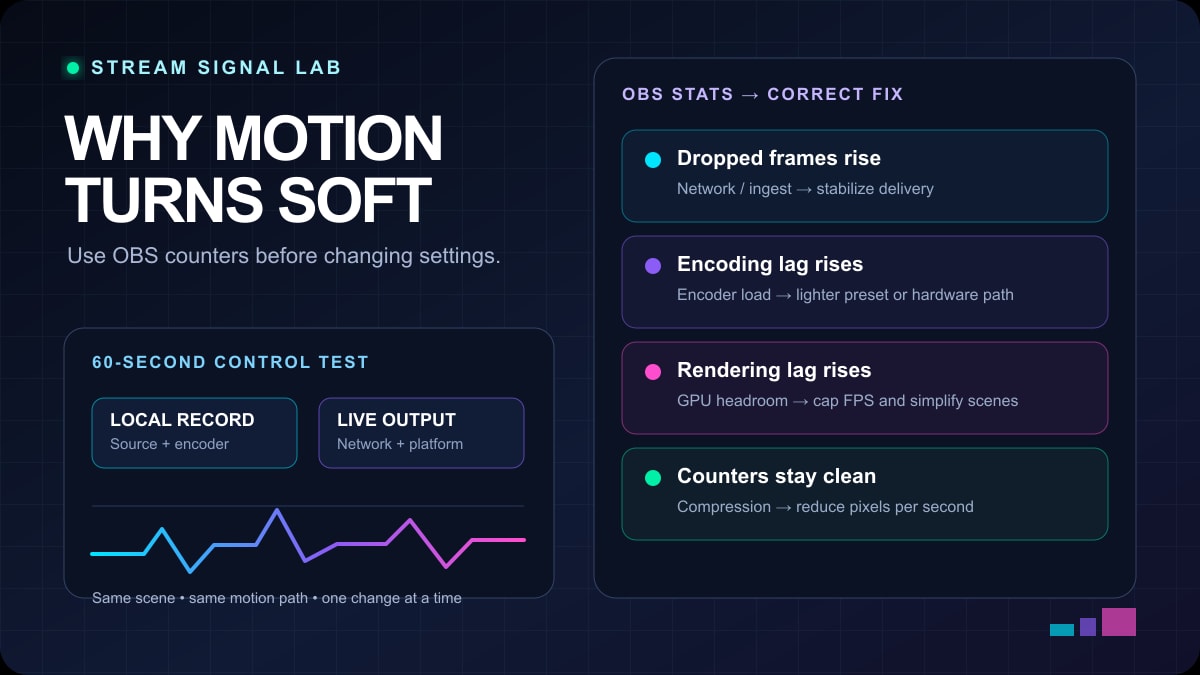
If performance worsens, first close unnecessary video tabs and animated dashboards, reduce unneeded OBS previews or projector outputs, update the operating system and graphics driver through their official channels, and retest. Do not immediately lower the broadcast resolution when the problem is a background browser video or an unsupported dock. The blurry-stream diagnostic guide separates connection, encoder, rendering, and movement-related symptoms when the visible problem is in the broadcast rather than on the second screen.
Troubleshoot a second streaming monitor
| Problem | What to check first | Safe next step |
|---|---|---|
| Both screens show the same thing | The system is in Duplicate/Mirror mode or uses a basic splitter | Choose Extend; if the computer detects only one signal, verify a supported independent output, dock, or adapter |
| The second display is not detected | Power, selected monitor input, cable seating, source port, dock, and display-support limit | Test one direct cable and one display, then use the operating system's Detect control and the computer maker's support path |
| Only a low resolution or refresh rate appears | A limit in the cable, adapter, dock, source port, display input, or current multi-display combination | Compare the specifications for the complete path and test a known-compatible direct connection |
| Text is blurry or windows change size | Non-native resolution, scaling, or mixed pixel densities | Restore each display's native resolution and test supported scale values separately |
| OBS opens off-screen after disconnecting | The saved window position belongs to a display that is no longer present | Reconnect the display, move the window back, or use the operating system's window-move controls before saving the layout |
| Stream audio moved to the monitor | HDMI/DisplayPort became the default playback device | Restore the intended Windows or macOS output and verify OBS monitoring and application-specific devices |
| The game or OBS starts stuttering | Second-screen video, browser activity, live projectors, driver state, or an unsupported display mode | Use a controlled local recording, close one workload at a time, and inspect OBS Stats before changing unrelated settings |
A pre-purchase checklist
- Define the job: chat, OBS controls, Multiview, editing, travel, or a future main display.
- Measure the desk: available width, depth, viewing distance, speaker space, camera sightline, and cable route.
- Verify the source: exact computer or GPU display count, output type, supported resolution, and refresh rate.
- Verify the complete connection: monitor input, cable direction, adapter or dock support, and any power-delivery requirement.
- Choose a resolution by workspace: 24-inch 1080p for basic controls or 27-inch 1440p when several useful windows need room.
- Choose orientation and support: landscape or portrait, stand adjustment, VESA pattern, monitor weight, and arm capacity.
- Read the exact warranty and return terms: especially dead-pixel handling, return shipping, refurbished status, and regional coverage.
- Ignore unverifiable superlatives: a product title saying “best for streamers” is not a test result.
- Test immediately: native resolution, full refresh rate, sleep/wake, audio routing, OBS workload, and all required cables before the return period ends.
Frequently asked questions
What is the best size for a second streaming monitor?
A 23.8- or 24-inch monitor is the most practical starting size for chat and controls on a normal desk. Choose 27 inches when you need several substantial windows or editing space and have enough viewing distance. Measure the desk and consider the primary screen's height before deciding.
Is 1080p enough for a secondary monitor?
Yes for a 24-inch chat, dashboard, and OBS-control screen. At 27 inches, 2560 × 1440 usually offers more usable workspace and finer text, although scaling and eyesight affect the experience. The secondary display does not need to match the stream's output resolution.
Does the second monitor need the same refresh rate?
No. Different supported refresh rates can coexist. Matching may make pointer and window motion feel more consistent, but chat and control panels do not need the primary gaming monitor's maximum rate. Test the full workload if a particular mixed-display combination behaves poorly.
Can one HDMI port extend to two monitors?
Not through a basic one-input splitter; that duplicates the signal. Independent extended displays require hardware that presents independent outputs, such as additional supported ports, a compatible dock or USB display adapter, or a supported DisplayPort MST arrangement. Check the exact computer's display limit first.
Do I need an NVIDIA or AMD graphics card for two monitors?
No. The requirement is a computer and display adapter that support the intended number of displays and connection modes. Integrated graphics can support multiple screens on many systems. Verify the exact processor, laptop, motherboard, or graphics-card specification rather than buying by brand alone.
Can I use a TV, tablet, or old monitor instead?
Often. An old monitor is the best no-cost trial if it has a compatible input. A TV can show dashboards but may be physically large or less comfortable for close text. A phone or tablet can carry chat or a platform dashboard without becoming a normal wired extended desktop. Test readability, latency, power, and app behavior before depending on it during a live session.
Should the secondary monitor be vertical?
Use portrait mode when long chat or moderation feeds dominate. Use landscape for the full OBS interface, Multiview, or several side-by-side tools. The stand or arm must support the rotation safely, and the operating system's orientation must match.
Sources and review scope
- Microsoft Support: How to use multiple monitors in Windows, external-monitor troubleshooting, and refresh-rate settings.
- Apple Support: connect displays and verify model-specific limits, MacBook Pro display counts and supported Thunderbolt chains, and extend or mirror the Mac desktop.
- OBS Project: Power of Projectors for preview, program, source, scene, and Multiview outputs.
- DisplayPort and VESA: current DisplayPort and MST FAQ and DisplayHDR certification criteria and product verification.
- Manufacturer specifications for the six current shortlist examples: Dell P2425H, HP 524pn, Dell P2725D, Dell P2725DE, ASUS PA278CGV, and ASUS MB16AHV.
The live search landscape and linked first-party documents were reviewed on July 24, 2026. Product availability, ports, firmware, operating-system labels, display limits, warranties, and prices change. Stream Mentor did not buy, instrument-test, color-calibrate, or produce an overall performance ranking for these monitors. Use the exact computer and monitor manufacturers' current specifications and independent lab measurements when choosing a specific model.