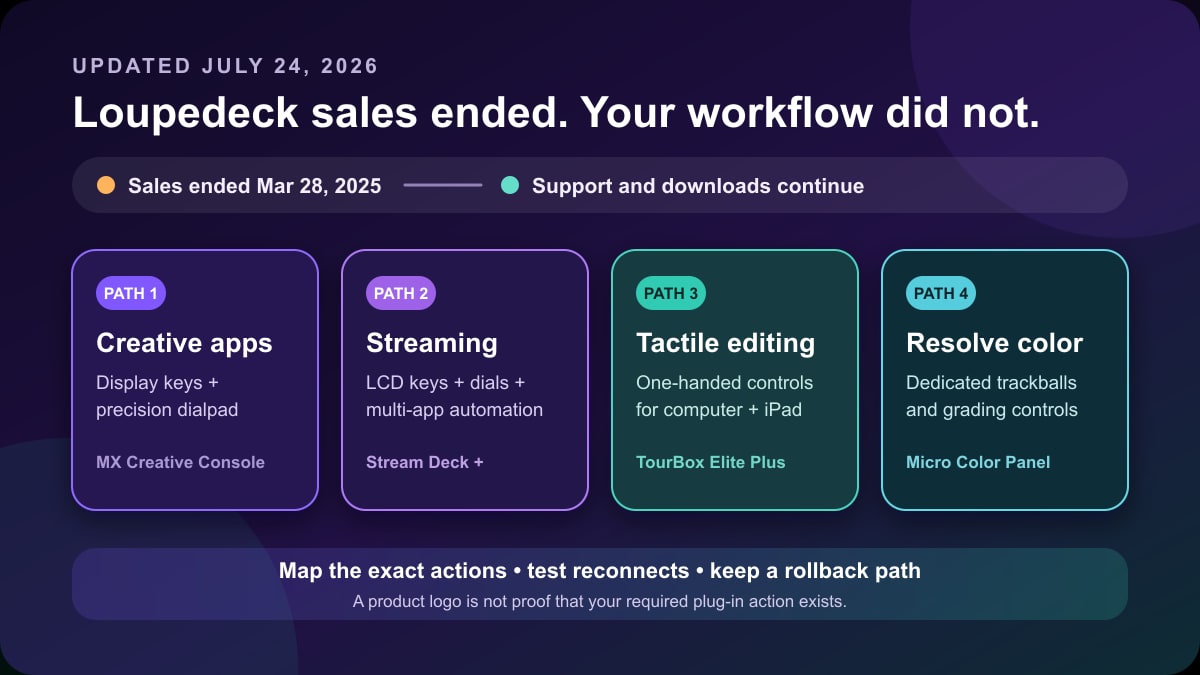
Quick answer: Logitech ended sales of the Loupedeck product line on March 28, 2025, but it did not announce the end of support. It said warranty claims and technical support would continue and that Loupedeck owners would receive future software updates and plug-ins through the shared platform introduced with software 6.0. The current support page still offers Loupedeck 6.3 for 64-bit Windows and macOS.
Best current alternatives: start with Logitech MX Creative Console for the closest successor ecosystem, Elgato Stream Deck + for streaming and general automation, TourBox Elite Plus for one-handed creative control across computers and supported iPad apps, or Blackmagic Design DaVinci Resolve Micro Color Panel for dedicated Resolve color work. They are not four interchangeable versions of Loupedeck. Choose the control shape and software integration that match the actions you perform every hour.
Checked July 24, 2026: Stream Mentor manually rebuilt this guide after reviewing Logitech's acquisition and sales-end notices, the live Loupedeck download page, and current manufacturer documentation for all four options. The former article used affiliate links, called unrelated audio and HDMI-switching hardware direct alternatives, claimed personal use without evidence, and repeated unsupported compatibility, durability, and pricing claims. Those rankings and links were removed. We did not buy or hands-on test these controllers.
What happened to Loupedeck?
Logitech announced its acquisition of Loupedeck on July 18, 2023. On March 28, 2025, Loupedeck published an end-of-sales notice: it would stop selling the Loupedeck product line and focus future development on Logitech MX Creative Console and its ecosystem.
The notice made three distinctions that used-device listings and old roundups often blur:
- Sales ended: Loupedeck stopped selling the product line directly on March 28, 2025, while remaining authorized-retailer inventory could sell through.
- Support was not declared over: the company said warranty claims and technical support would continue as usual.
- Software paths converged: it said release 6.0 introduced a shared backend with MX Creative Console and that Loupedeck owners could use future updates and plug-ins developed for that platform.
The current Loupedeck software download page lists version 6.3 for 64-bit Windows and macOS. It also warns that some legacy plug-ins, including Razer plug-ins, work only with software 5.9.1. This is why “still supported” does not mean that every old plug-in works in the newest release, or that a used console will match a current operating system forever.
Four current Loupedeck alternatives
| Option | Control approach | Best starting use | Main limitation to understand |
|---|---|---|---|
| Logitech MX Creative Console | Display-key keypad plus separate wireless dialpad, roller, and buttons | Creative apps and the closest official ecosystem migration | Different physical layout; existing Loupedeck profiles are not proof of one-click hardware migration |
| Elgato Stream Deck + | Eight LCD keys, four push encoders, and a touch strip | Streaming, audio adjustments, shortcuts, and multi-app automation | Fewer dedicated tactile controls than a dense editing console; workflow depends on plug-ins and pages |
| TourBox Elite Plus | One-handed tactile buttons, wheels, and dials over dual-channel Bluetooth | Illustration, photo, video, and supported iPad creative apps | No display labels on each physical control; memorization and profile design matter |
| DaVinci Resolve Micro Color Panel | Dedicated trackballs, rings, and Resolve color controls | Color correction and grading in DaVinci Resolve | Specialist Resolve panel, not a general streaming or universal macro deck |
A good replacement does not need to look like a Loupedeck. It must reduce friction in the actual workflow. A photo editor who adjusts exposure and crops all day, a streamer who changes scenes and audio, an illustrator who keeps one hand on a pen, and a Resolve colorist need different controls.
1. Logitech MX Creative Console: closest successor ecosystem
MX Creative Console is the first option to evaluate because Logitech and Loupedeck explicitly shifted future development toward it. It combines an MX Creative Keypad with dynamic display keys and a separate MX Creative Dialpad with a contextual main dial, roller, and customizable buttons.
Logitech says profiles and plug-ins are managed through Logi Options+ on Windows and macOS. Its current documentation lists integrations for applications including Photoshop, Premiere Pro, Lightroom and Lightroom Classic, Illustrator, Final Cut Pro, DaVinci Resolve, Figma, Zoom, Microsoft Teams, and Spotify. For an app without a marketplace plug-in, Logitech says a user can build a profile from the keyboard shortcuts that application exposes.
Choose it when:
- you want the platform Logitech identifies as the development focus after Loupedeck sales ended;
- you value visible action labels plus a separate precision dial;
- your important apps appear in the current Logi Options+ marketplace or expose usable shortcuts;
- you work on a supported Windows or Mac computer and are comfortable maintaining profiles in Options+.
Verify before switching: make a list of every Loupedeck action and confirm the matching MX plug-in action or keyboard shortcut. The shared backend and future plug-in statement does not mean the two devices have identical buttons, screens, pages, haptics, or profile files. Rebuild and test the workflow rather than assuming an automatic hardware mapping.
Logitech's US launch announcement listed the console at $199.99 in 2024, and its current US store showed the same price during this July 24, 2026 review. Price, stock, bundled Adobe offer, and return terms vary by market and time; treat those as checkout facts rather than permanent specifications.
2. Elgato Stream Deck +: best fit for streaming and general automation
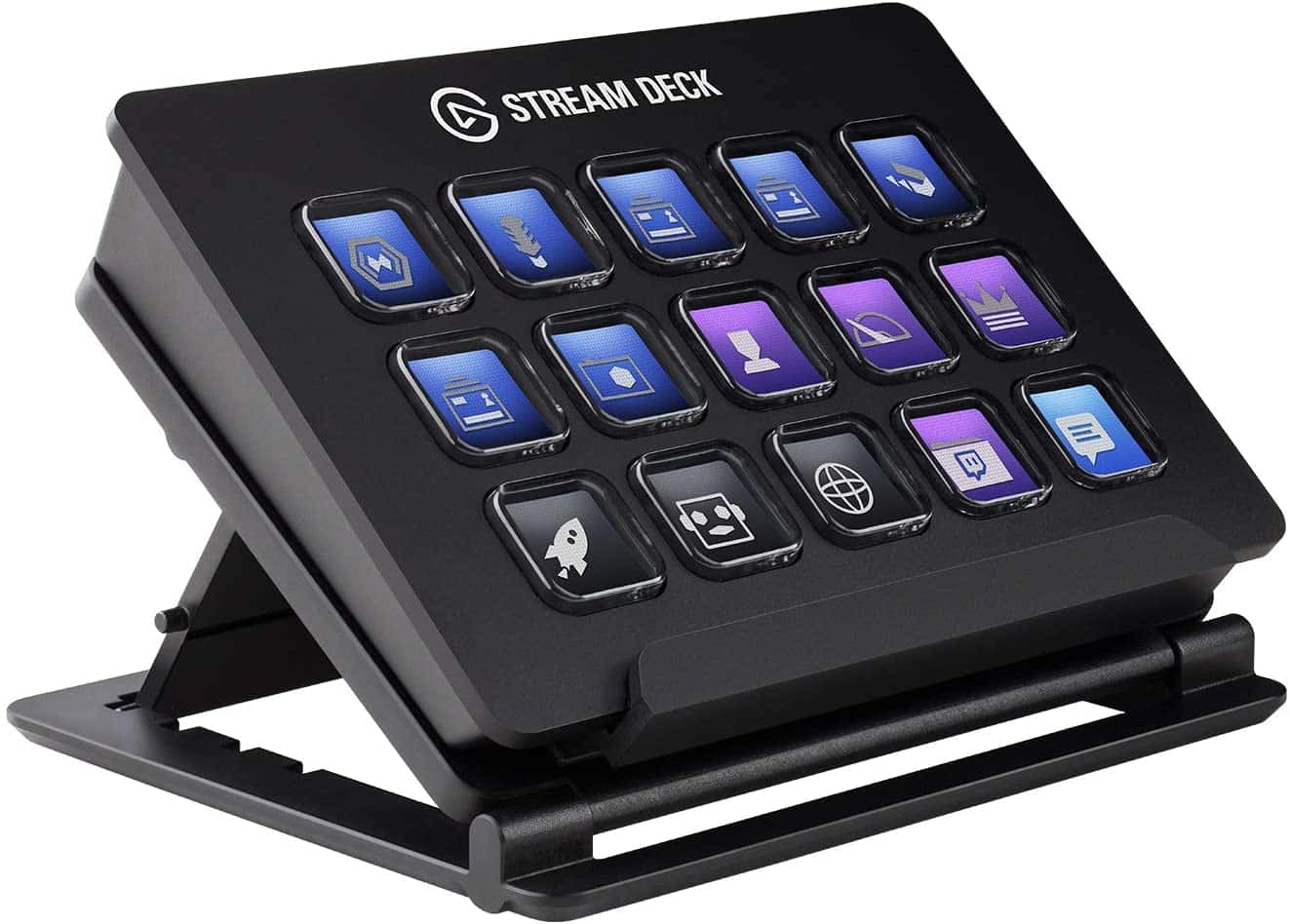
Stream Deck + combines eight customizable LCD keys, four 360-degree encoders with push functions, and an LCD touch panel. Elgato positions it as a studio controller, production console, and audio mixer interface rather than a color-grading surface.
The visible labels are useful when one control changes by page or application. Encoders suit values such as volume, lighting, zoom, or other incremental controls when the corresponding plug-in exposes them. Keys suit actions such as scene changes, source visibility, application launch, marker creation, or multi-action sequences. A display page can hold related actions instead of requiring a dedicated physical button for every command.
Choose it when:
- streaming, meetings, audio levels, studio controls, and cross-application shortcuts are the main job;
- you want display keys and rotary adjustment in one USB device;
- the required apps and devices have current Stream Deck plug-ins or usable hotkeys;
- you accept page navigation in exchange for flexible labels and automation.
Verify before switching: open Elgato's marketplace and support pages and confirm the exact plug-in, operating-system requirement, account requirement, device model, and action list. A plug-in name alone does not prove that it exposes the parameter or feedback you need. Elgato's current product page lists Windows and macOS compatibility; its current support page should be used for the specific Stream Deck software release requirements.
The US product page showed $159.99 for the black model during this review. Regional price, promotions, stock, and compatible accessories can change. Budget any USB dock, stand position, cable routing, paid third-party plug-in, or additional audio hardware separately.
3. TourBox Elite Plus: one-handed tactile creative control
TourBox Elite Plus is designed around one-handed use with differently shaped physical controls. TourBox documents dual-channel Bluetooth switching and use with Windows, macOS, and supported iPad apps. Its current page lists workflows across illustration, animation, photo editing, video editing, color correction, 3D, and audio applications.
The manufacturer says supported iPad apps include Clip Studio Paint, Procreate, Photoshop, Lightroom, Capture One, Affinity, DaVinci Resolve, Blender, and Cubase, while Windows and macOS integrations cover creative applications as well. It documents preloaded presets, custom mappings, app-specific profiles, single-press, double-press, and combination operations.
Choose it when:
- one hand stays on a pen, mouse, or tablet and the other needs tactile controls;
- you prefer controls distinguishable by position and shape instead of reading an LCD key;
- iPad is part of the workflow and the exact target app appears in TourBox's current compatibility material;
- you are willing to learn and maintain application-specific mappings.
Verify before switching: check the exact application, operating-system version, connection mode, and action support. “Supports Photoshop” or “supports iPad” is too broad if the workflow depends on one command, continuous adjustment, device switching, or feedback state. Try the complete shortcut set within the seller's return window.
TourBox's direct page uses market-specific and promotional pricing, so this guide does not freeze one global number. Compare the exact Elite Plus model with other TourBox variants; a lower-priced model may differ in connection, platform, or hardware behavior.
4. DaVinci Resolve Micro Color Panel: specialist choice for Resolve grading
The DaVinci Resolve Micro Color Panel is the strongest choice here only when DaVinci Resolve color work is the central task. Blackmagic describes it as a compact color panel with dedicated controls, Bluetooth or USB-C connectivity, and support for refined grading functions including windows.
Blackmagic's current documentation says its Micro and Mini color panels include 12 primary color-correction knobs for parameters such as contrast, saturation, hue, temperature, tint, midtone detail, color boost, shadows, and highlights. The trackballs and rings are designed for tonal-range color and level adjustments. This direct, simultaneous control is fundamentally different from mapping a generic macro key to a command.
Choose it when:
- the user spends substantial time in the Color page of DaVinci Resolve;
- dedicated trackballs, rings, and correction controls matter more than universal app switching;
- the panel's current Resolve and operating-system requirements fit the workstation;
- a specialist surface is worth desk space and budget.
Do not choose it as a general Loupedeck substitute for OBS scenes, arbitrary application macros, social posting, photo cataloging, or broad system control. It is a Resolve color panel. Blackmagic's US page listed it at $559 during this review; regional prices and resellers differ.
Why the old alternatives were removed
The previous guide ranked Behringer X-Touch Mini, DaVinci Resolve Mini Panel, Elgato Stream Deck, and FEELWORLD LIVEPRO L1 as if they solved the same task. That list mixed distinct categories:
- Behringer X-Touch Mini is fundamentally a compact USB/MIDI controller. It can be useful in supported audio or custom-mapping workflows, but the old page did not prove direct Lightroom, Final Cut Pro, and Premiere parity with Loupedeck.
- FEELWORLD LIVEPRO L1 is an HDMI live-production switcher. Switching camera signals is not a substitute for an editing and shortcut console.
- DaVinci Resolve Mini Panel remains a legitimate dedicated Resolve color surface, but Blackmagic now also offers the smaller, lower-cost Micro Color Panel. Neither is a universal controller.
- Stream Deck remains relevant, but Stream Deck + is the closer comparison when rotary controls are part of the requirement.
A product can be good at its own job without being a good Loupedeck replacement. Category accuracy matters more than the number of items in a roundup.
Should an existing Loupedeck owner replace it now?
Not automatically. If the console works, the required plug-ins work, the operating system is stable, and the current Loupedeck software meets the workflow, continued use can be lower risk than an immediate migration. The end of new product sales is a reason to create a contingency plan, not proof that every installed device stopped functioning.
Keep the following record:
- console model, serial number, purchase date, and warranty evidence;
- working Loupedeck software, operating-system, application, and plug-in versions;
- screenshots or written maps of every page, action, dial, and custom profile;
- official installer source and account access—without redistributing proprietary installers;
- USB cable, hub, power, sleep, and reconnect behavior;
- a list of actions that would block work if a plug-in or device failed.
Do not freeze a production computer indefinitely without security updates merely to preserve one plug-in. Instead, test supported upgrades on a separate machine or recoverable system image and decide whether to maintain, replace, or isolate the workflow.
Used Loupedeck buying checklist
A used Loupedeck may still be reasonable for a documented, compatible workflow, but end-of-sales status changes the risk. Before paying:
- Identify the exact model: Loupedeck, Loupedeck+, Live, Live S, and CT have different hardware and workflows.
- Check the live support page: confirm the model, software download, current OS, target application, and required plug-in.
- Ask about account or license state: establish what, if anything, must transfer and whether the seller can legitimately do so.
- Inspect every input: test screens, touch regions, buttons, dials, wheel, USB connector, cable, stands, and power or reconnect behavior.
- Test the actual app: a device lighting up does not prove that the necessary plug-in action works.
- Review warranty reality: continued warranty service does not mean a second-hand unit has remaining or transferable coverage.
- Require a return path: avoid an untestable final-sale device unless the price reflects total failure risk.
- Compare migration cost: add time spent recreating profiles and the likely replacement horizon to the used price.
The support page notes that some legacy plug-ins work only with 5.9.1, while the current download is 6.3. If a used-device pitch depends on one legacy plug-in, verify that exact stack before purchase. Do not download installers or plug-ins from an unknown mirror.
How to choose by workflow
| Primary workflow | Start with | Proof required before purchase |
|---|---|---|
| Photoshop, Lightroom, Premiere, and general creative work | MX Creative Console | Required current Logi Options+ plug-ins and every high-frequency adjustment |
| OBS scenes, audio, lighting, calls, and broad automations | Stream Deck + | Exact marketplace actions, state feedback, and reconnect behavior |
| Pen-tablet, illustration, and one-handed editing | TourBox Elite Plus | Exact desktop or iPad app, shortcuts, and control feel within return window |
| DaVinci Resolve color correction and grading | Resolve Micro Color Panel | Current Resolve compatibility and the real Color-page workflow |
| A working installed Loupedeck | Keep it while planning migration | Current support, OS, plug-ins, configuration record, and replacement trigger |
Someone splitting time across these jobs may need two specialist devices or one more general controller with compromises. For example, Stream Deck + can trigger Resolve shortcuts, but it does not become a three-trackball color panel. The Resolve panel can grade precisely, but it does not become an LCD-key streaming controller.
Migration test: rebuild the work, not the button count
- Inventory actions for one week. Record the commands, adjustments, pages, and applications actually used, plus how often they occur.
- Rank the top 20. Separate continuous adjustments such as exposure or volume from single actions such as export or scene change.
- Map each action. Mark native plug-in, keyboard shortcut, multi-action, unsupported, or uncertain. A marketing app logo is not an action-level answer.
- Build one complete workflow. Recreate a real edit, stream, or grading session before migrating every profile.
- Test state and context. Verify the correct profile follows the active app, keys show the expected state, dials change the intended value, and a second press does not trigger the wrong context.
- Disconnect and restart. Test sleep, wake, USB or Bluetooth reconnect, app crash, device restart, and computer reboot.
- Use another operator. Labels and documentation should make sense to someone who did not create the profile.
- Keep rollback. Retain the working Loupedeck and configuration record until the replacement completes several real projects.
Do not count saved keystrokes in a staged five-minute demo and call the migration complete. Measure setup time, wrong actions, app switching, adjustment accuracy, recovery, and whether the operator can work without hunting through pages.
Frequently asked questions
Is Loupedeck discontinued?
New Loupedeck product-line sales ended on March 28, 2025. Loupedeck's notice said remaining authorized-retailer inventory could sell through and that warranty claims, technical support, future software updates, and plug-ins would continue. Check the live support pages for the current state rather than treating the 2025 promise as an unlimited guarantee.
Does Loupedeck software still work?
The official support site offered Loupedeck 6.3 downloads for 64-bit Windows and macOS when checked July 24, 2026. It also offered 5.9.1 because some legacy plug-ins do not work on the newer branch. Compatibility depends on the console, OS, application, and plug-in version.
What is the closest replacement for Loupedeck?
MX Creative Console is the closest official ecosystem successor because Logitech ended Loupedeck sales to focus on it and says the platforms share a backend. It is not physically identical. Compare every required action and rebuild the workflow before retiring a working Loupedeck.
Is Stream Deck + better than MX Creative Console?
It depends on the job. Stream Deck + is a strong starting point for streaming, studio control, visible shortcuts, and automation. MX Creative Console is oriented toward creative applications with a separate display-key keypad and precision dialpad. Plug-in action coverage is more important than the brand list.
Can a MIDI controller replace Loupedeck?
Only for workflows where the target software accepts the necessary MIDI messages directly or through a dependable mapping layer. A MIDI device does not automatically provide Loupedeck's app profiles, display labels, contextual switching, or plug-ins. Test every action and feedback requirement.
Is a video switcher a Loupedeck alternative?
No, not for editing or general shortcut control. A hardware video switcher selects and mixes video signals. It can complement a control console in a live setup, but its core job is different. That is why FEELWORLD LIVEPRO was removed from this replacement list.
Sources and review scope
- Logitech Newsroom: July 18, 2023 Loupedeck acquisition announcement.
- Loupedeck: March 28, 2025 sales-end and support notice for sales status, continued support statement, and shared-platform direction.
- Loupedeck Support: current software download page for versions 6.3 and 5.9.1 and the legacy-plug-in warning.
- Logitech: MX Creative Console product and configuration guide for app profiles, plug-ins, custom shortcuts, contextual controls, and independent keypad or dialpad use.
- Elgato: Stream Deck + product and technical-specification page for its eight LCD keys, four push encoders, touch panel, connection, and Windows/macOS positioning.
- TourBox: TourBox Elite Plus product page for dual-channel Bluetooth, Windows, macOS, iPad, supported-app, and profile claims.
- Blackmagic Design: DaVinci Resolve control-panel page for Micro Color Panel controls, connectivity, workflow scope, and the July 24, 2026 listed US price.
Official product documentation and the visible replacement landscape were reviewed on July 24, 2026. Stream Mentor did not buy, borrow, benchmark, or long-term durability-test these controllers. Rankings are workflow-based, not affiliate-based. Prices, stock, plug-ins, operating-system support, promotions, and Loupedeck lifecycle details can change, so verify the exact current pages before purchase or migration.